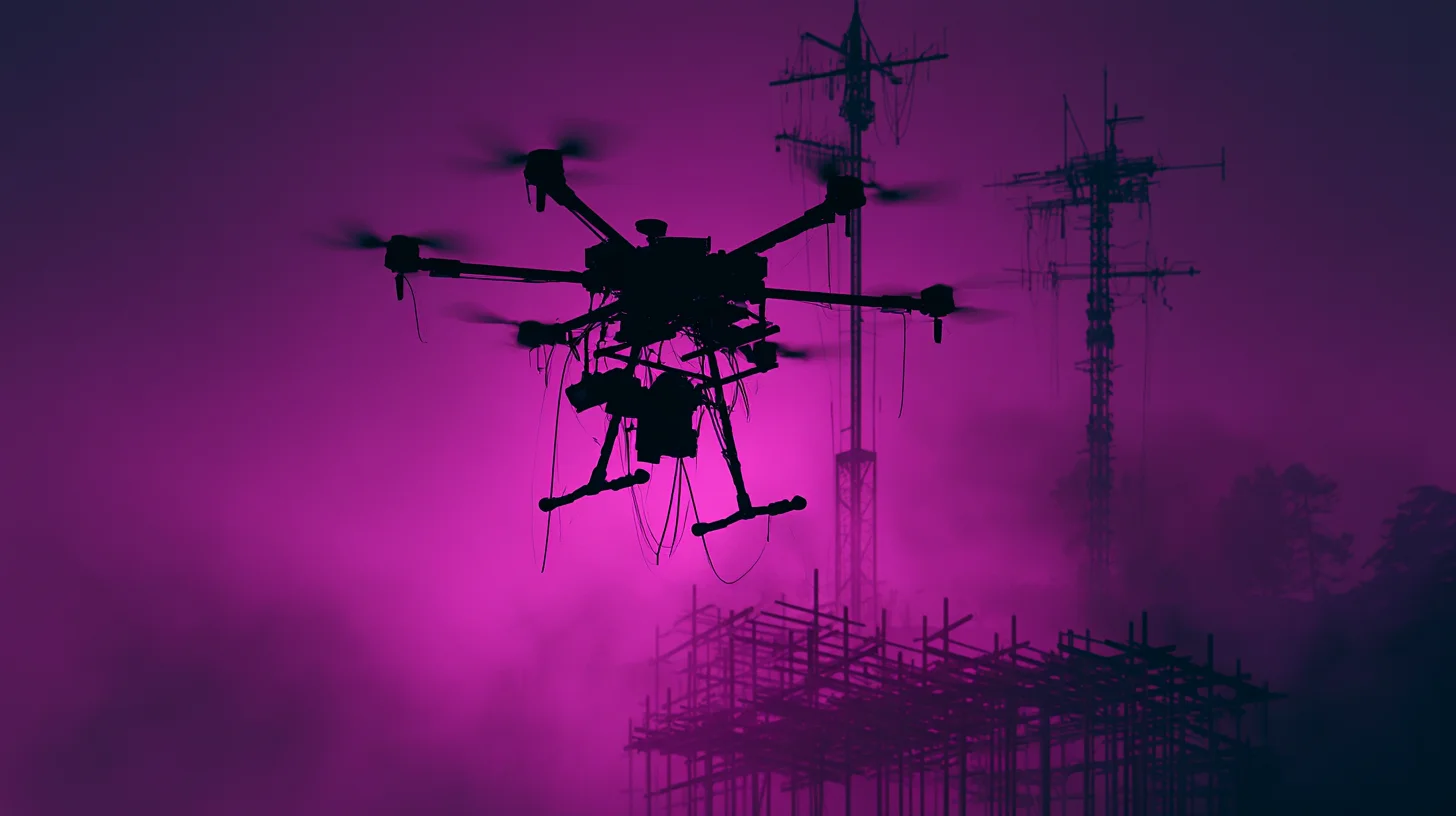
Zero-trust for robots: what ZTASP's chip-to-cloud architecture means for construction sites and smart buildings
ZTASP's chip-to-cloud assurance stack reaches TRL 7. Here is what it means for construction drones, BIM digital twins, and EU AI Act compliance.
The perimeter is already gone
A drone inspecting a bridge abutment, a ground robot laying rebar, a sensor mesh embedded in a hospital ceiling — none of these agents live inside a trusted network. They operate at the edge, they hand off decisions faster than any human can review, and the old castle-and-moat security model was never designed for them. The GoZTASP white paper, published through the IEEE Spectrum / Wiley Knowledge Hub and sponsored by the Technology Innovation Institute (TII) in Abu Dhabi, proposes a concrete architecture for this problem: a chip-to-cloud assurance stack that treats every agent, every message, and every sensor reading as untrusted until continuously verified.
←TODAY: Construction sites in 2026 run inspection drones, autonomous rebar bots, and BIM-linked sensor meshes — each a potential attack or failure vector with no unified governance layer.
→3012: In the Zurich-3012 horizon, the building site IS the distributed robot; assurance architecture is as fundamental to the Leistungsverzeichnis as structural calculations.
Fulcrum: The insight that zero-trust is not a cybersecurity upgrade but a design discipline for any system where trust cannot be assumed at the boundary.
How the stack is wired
ZTASP integrates drones, unmanned ground vehicles, fixed sensors, and human operators into a single governance layer through two named subsystems. Secure Runtime Assurance (SRTA) enforces safety constraints on individual agents in real time — drawing on simplex architecture and control barrier functions, the same formal methods used in safety-critical aerospace systems. Secure Spatio-Temporal Reasoning (SSTR) handles coordination across the heterogeneous fleet: it gives each agent context about where every other agent is, what it is doing, and whether its behaviour is within certified bounds.
The named hardware anchor is the Saluki secure flight controller, which has reached TRL 8 — meaning system complete and qualified per the NASA/ESA maturity scale — and is already deployed in customer systems. The broader ZTASP platform sits at TRL 7, validated in mission-critical operational environments. These are self-reported figures from a sponsored white paper, so independent third-party certification is not yet on the table. That gap is worth naming: TRL claims without audit trails are a procurement risk, not a green light.
The engineering trade-offs are structural. Continuous verification adds latency. Edge devices — a drone’s flight controller, a sensor node — have hard computational limits. Communication links degrade in dense construction environments or underground. The ZTASP architecture claims resilience under degraded conditions, but the white paper offers no published latency benchmarks or fault-recovery timings. Any practitioner specifying this class of system needs those numbers before they write a BEP clause around them.
Why this lands on an architect’s desk
The PAZ relevance is not abstract. ZTASP’s layered trust problem is structurally identical to what a BIM-integrated digital twin faces: sensors, edge gateways, cloud platforms, and human operators all need continuous identity verification, not a one-time login at system startup. Per ENISA’s IoT/edge security guidance, heterogeneous device networks are the highest-risk surface in building automation — HVAC, access control, structural monitoring all share the same failure pattern ZTASP is designed to govern.
There is also a regulatory dimension that is arriving fast. The EU AI Act classifies autonomous systems in transport and critical infrastructure as high-risk, mandating human oversight mechanisms and continuous risk monitoring — exactly what SRTA is designed to provide. EASA’s U-Space framework for drone operations adds a second layer: autonomous drone fleets operating in European airspace will need governance architectures that can demonstrate compliance to a regulator. ZTASP’s chip-to-cloud lineage maps directly onto that compliance obligation, even if the platform was built for a different geography.
ETH Zurich’s Autonomous Systems Lab and EPFL’s robotics groups are active in formal verification for multi-agent systems — the academic substrate for SRTA-type approaches already exists in the DACH research ecosystem. What is missing locally is the productised, TRL 7+ assurance layer that closes the gap between a lab robot and a certified site machine.
Atelier: If your office is specifying autonomous inspection drones or robotic systems for a hospital, transport hub, or infrastructure project, the governance architecture is now a design deliverable — not an IT department afterthought. Map your agent types (drone, UGV, fixed sensor, human), identify every trust boundary they cross, and ask the system integrator which TRL-validated assurance layer governs each one. If they cannot answer, that is your critical path item.
Read the ZTASP white paper on the IEEE Spectrum Knowledge Hub with the TRL claims noted, then pull NIST SP 800-207 (the foundational zero-trust specification) alongside it. The contrast between the theoretical framework and the operational product will tell you exactly how much engineering work remains between the white paper and your site.
Source: IEEE Spectrum
SOURCE · ↗