
The Embarcadero Freeway Died So Your City's Next Viaduct Doesn't Have To
San Francisco's Embarcadero Freeway reveals a system boundary failure still relevant to European urban infrastructure decisions in 2026. PAZ Academy analysis.
Concrete Ambition, Urban Consequence
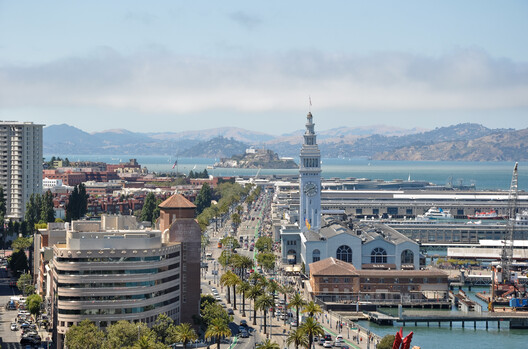
In 1959, the first section of San Francisco’s Embarcadero Freeway opened — a double-deck concrete viaduct that severed the city’s historic waterfront from its downtown core. By 1991, it was gone. The 1989 Loma Prieta earthquake damaged the structure badly enough to force a decision the city had been avoiding for decades: tear it down. What replaced it was one of the most-cited urban regeneration outcomes in North American planning history, and as ArchDaily’s Moises Carrasco documented in April 2026, the case study is still teaching.
←TODAY: At least a dozen European cities — including several in the DACH region — are mid-debate on elevated ring roads, urban motorways, and freight-rail viaducts that bisect walkable quarters.
→3012: In the Zurich-3012 horizon, infrastructure lifecycles are modelled as urban organisms: insertion, metabolism, extraction — each phase costed in social and environmental currency before the first pile is driven.
Fulcrum: The gap between those two moments is exactly the decision architecture that practitioners can design today.
The System Behind the Signal
The Embarcadero Freeway was not a rogue project. It was a node in San Francisco’s 1948 Trafficways Plan — a comprehensive postwar traffic framework whose primary objective was a high-capacity, high-speed link between the Bay Bridge and the Golden Gate Bridge. The logic was coherent within its own system: prioritise vehicular throughput, complete the downtown distributor loop, absorb projected postwar automobile growth. Seoul’s Cheonggyecheon elevated highway, Boston’s Central Artery, and Taipei’s Zhongxiao Bridge followed similar system logic. All were eventually demolished.
What the 1948 planning model lacked was a feedback loop. There was no mechanism to re-evaluate the urban cost once the infrastructure was operational — no equivalent of what we would now call a post-occupancy evaluation at the city scale. The system was open-loop: input (traffic demand), output (concrete lanes), no return signal from the waterfront economy, pedestrian severance, or property value gradients on either side of the deck.
Montreal’s counter-example, cited in the ArchDaily piece, is instructive: public opposition rerouted a planned viaduct before construction, preserving heritage fabric and waterfront sightlines. The difference was a closed loop — community feedback entered the system early enough to redirect the design. That is the structural lesson, not the aesthetic one.
What This Means on Your Desk This Week
If you are working on urban infrastructure in 2026 — a mobility hub, a highway-cap park, a logistics viaduct repurposing, a SIA 261-adjacent structural assessment for an existing overpass — the Embarcadero genealogy is directly relevant. The failure mode is not engineering; the failure mode is system boundary definition. When the Trafficways Plan was drawn, the boundary was traffic throughput. The waterfront, the neighbourhood grain, the pedestrian layer — all were externalities.
Modern BIM-to-urban workflows, particularly those integrating parametric urban modelling tools like Grasshopper + Ladybug for pedestrian wind and solar access, or ESRI’s ArcGIS Urban for land-use impact simulation, can make those externalities visible at the decision stage. The tools exist. The discipline of applying them before schematic design is approved — that is still the gap.
The risk is real and worth naming plainly: infrastructure optimised for one variable (throughput, freight capacity, flood conveyance) will consistently underperform on every variable excluded from the model. That is not a political statement; it is a system property.
Atelier: In PAZ’s urban infrastructure modules, we frame this as the LOIN problem applied to city systems — Level of Information Need must include social and economic adjacency data, not just structural loads and geometric clearances. When teams scope a feasibility study, the first question should be: what is outside our system boundary, and what is the cost of keeping it there?
The Move
Pull the ArchDaily case study (Carrasco, April 2026) alongside the documented Seoul Cheonggyecheon restoration metrics — 120,000 daily pedestrian trips, measurable urban heat island reduction — and use both as reference benchmarks when your next infrastructure brief arrives. Map the system boundary explicitly in your first workshop. List the variables inside it and the variables deliberately excluded. Then price the exclusions. That one exercise, done at project inception, is the difference between a structure your city celebrates in 30 years and one it demolishes.
SOURCE · ↗