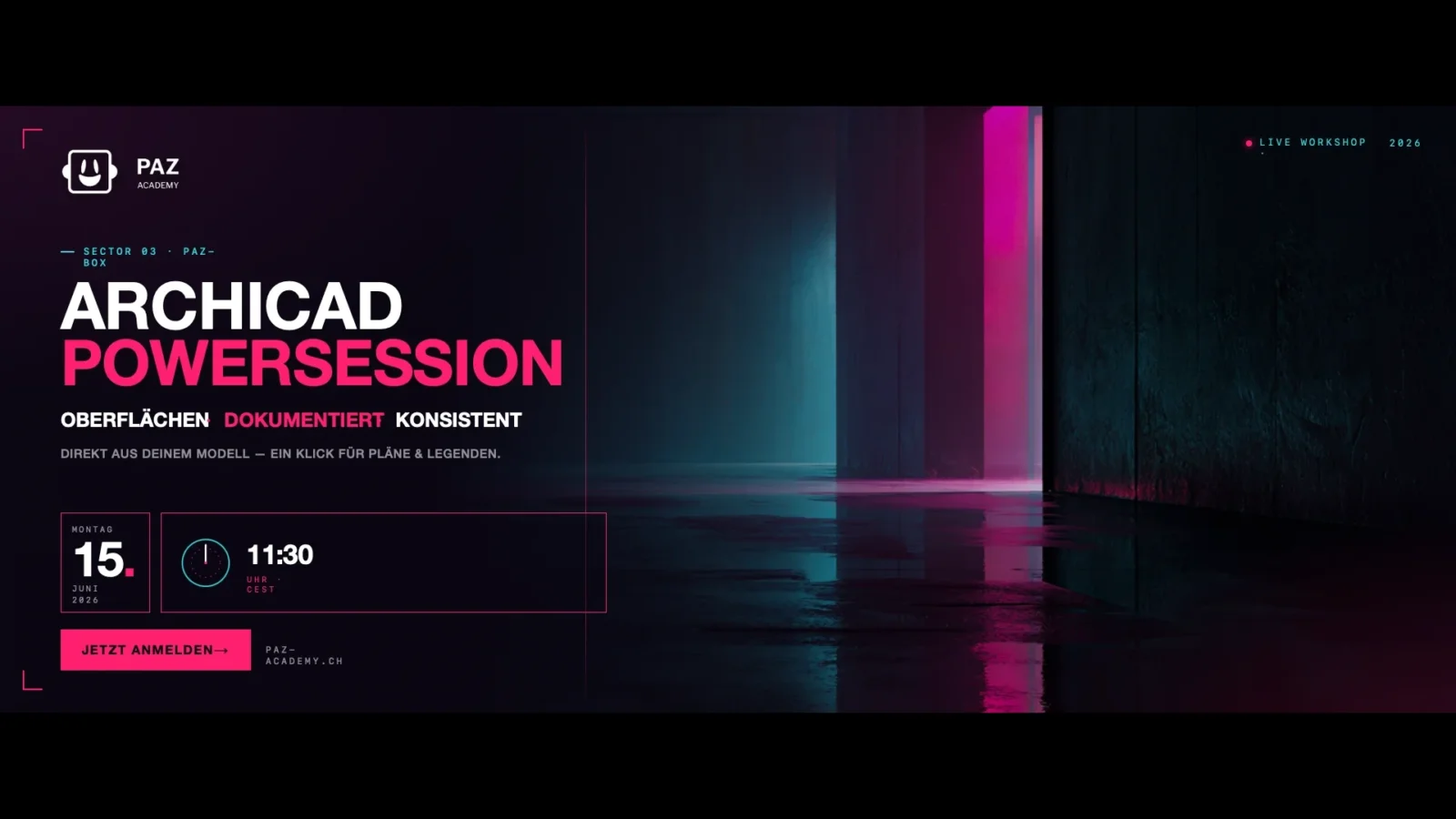
Wall finishes shouldn't be a second job: our 15 June Archicad Power Session
Free 30-min PAZ Academy Power Session, 15 June 2026: organise Archicad wall finishes as model data with the PAZ-BOX so lists and legends stay in sync.
Every architect knows the loop. You tune a wall surface by hand, then jump to the schedule to check it landed, then to the legend, then to the material list — three separate places to keep one decision honest. Change the room layout next week and the whole reconciliation starts again. We call it material micromanagement, and on 15 June, 11:30–12:00, our atelier is running a free online Archicad Power Session to take it off your desk.
Materialisierung — Wandfinishes is a thirty-minute, hands-on session on smarter wall-finish and surface workflows in Archicad: organising surfaces centrally and consistently, controlling materials visually in the model rather than in a side table, and letting lists, legends and documentation update themselves when the design moves. It runs in German, online, with deliberately limited seats so it stays interactive — bring a live question from your own project.
←TODAY: In a 2026 office, a single layout change can trigger an afternoon of re-checking finishes across plan, schedule and legend. →3012: The materialisation of a room becomes a property of the room, authored once and read everywhere. Fulcrum: The win is not faster clicking — it is removing the second source of truth, so the model and the documentation can never disagree.
Why a surface is really a data problem
A wall finish feels like a drawing decision, but it behaves like a database join. The finish has to know which room it belongs to, where the room boundary actually sits, which layer it lands on, and how it should read in 2D versus 3D. Do that by hand and you are maintaining the same fact in four files. PAZ has covered this thread before: our WandfinishPro add-on reads the Raumstempel — the room stamps already in your model — and generates the finishes as 3D objects visible in section and elevation and as 2D annotations on plan, with per-room control of the Raumflächenbegrenzung that decides where a finish begins and ends. One source, two representations, automatic quantity take-off. The session works directly with the PAZ-BOX, so you see those moves on real workflows, not slideware.
The timing is not incidental. As AEC Magazine reported this spring, Graphisoft is previewing a collaboration layer that keeps models, documents, issues and decisions synchronised across a team — the industry is converging on the same idea from the top down. Materialisation is where that idea meets the floor: if your finishes are authored as model data, they travel cleanly into every coordinated view downstream. If they live as manual overrides, they break at the first handover.
Atelier: For a Swiss interior or competition team, the concrete payoff is the Ausführungsplanung pass — wall-finish plans that regenerate instead of being redrawn, with the boundary logic flexible enough for real interior cases rather than only tidy rectangular rooms.
Hack: This Hack teaches you to count the materialisation work in your model before you automate it — because every room stamp is one finish job. Open the Archicad Python connection and ask the model how many zones it carries; the number is your finish workload, and your sanity check after any layout change. Run this against a live, open project:
from archicad import ACConnection
conn = ACConnection.connect()
acc = conn.commands
zones = acc.GetElementsByType('Zone')
print(f"{len(zones)} Raumstempel \u2014 each one a wall-finish to author")
If that number jumps after a design change and your finish plan didn’t, you have just found the gap the session is built to close.
We build schools so the next workshop has students and the last one has heirs — automate the repetitive surface accounting, and you keep your attention for the decisions that actually need an architect. Reserve a seat, open a messy project, and bring the wall that always breaks your schedule.