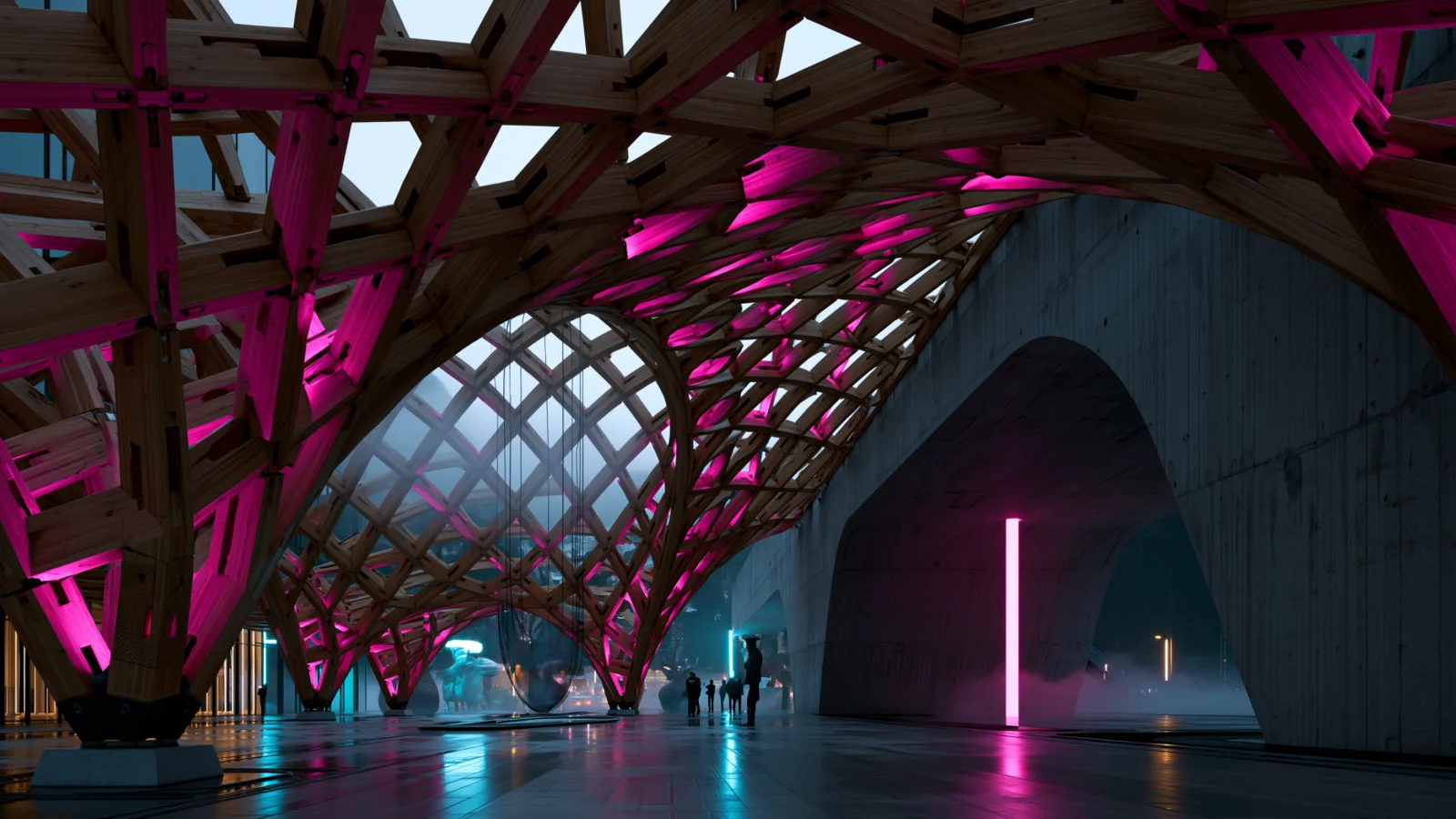
Catenary: The Curve That Decides Where the Force Goes
How the catenary curve (y=a·cosh(x/a)) form-finds arches and vaults — from Hooke and Gaudí to ETH Zürich's Thrust Network Analysis, with runnable Python.
Ask a structural engineer to name the oldest computer in architecture and the honest answer is a piece of string. Hang a chain between two points, let it settle, and it draws — without instruction, without iteration — the one curve that resolves its own weight in pure tension. That curve is the catenary, y = a·cosh(x/a), and it is the quietest example I know of a system making a decision a human cannot make by hand. The question I keep returning to is the one this whole concept poses: who, exactly, is doing the designing when gravity draws the line?
←TODAY: In 2026 a Grasshopper + Kangaroo solver finds a funicular shape in milliseconds that took Frei Otto’s Stuttgart team weeks of physical chain-models in 1975. →3012: By the Zurich-3012 horizon, form-finding is ambient — every structure negotiates its own geometry with its load case in real time. Fulcrum: The catenary is the proof, three centuries old, that the most reliable designer of a load-bearing shape was never the architect — it was the force, and our job is to specify the conditions it answers.
What it is: A catenary is the curve a uniform flexible cable assumes hanging under its own weight between two supports. Every infinitesimal segment sits in pure tension; there is no bending anywhere along it. The equation is a hyperbolic cosine, and the single constant a — the ratio of horizontal tension to weight per unit length — controls how deep or shallow the sag runs. Invert the curve and the sign of every internal force flips: pure tension becomes pure compression. An arch shaped on an inverted catenary, loaded only by its own weight, carries that load through the thickness of stone or brick without bending. And bending, for masonry, is the enemy. The catenary removes it.
Why it works: The principle is funicularity — a shape that is in equilibrium with a given load purely through axial force. It rests on real mechanics, not aesthetics: resolve the vertical equilibrium of a hanging differential element and the only solution is the cosh. Robert Hooke compressed the structural consequence into a single line in 1675: ut pendet continuum flexile, sic stabit contiguum rigidum inversum — as hangs the flexible line, so but inverted stands the rigid arch. The catch a professional must respect: real arches carry more than self-weight. Add snow, wind, an asymmetric live load, and the funicular shape shifts with the load case. This is exactly where ETH Zürich’s Block Research Group rebuilt Hooke’s insight as a numerical method — Thrust Network Analysis takes a load distribution and a plan geometry, solves for the network of compressive force paths, and reads the surface off the resulting funicular polyhedron. The shape is found, not drawn.
Origins: For fifty years after Galileo’s Two New Sciences (1638), Europe looked at a hanging chain and saw the wrong curve — Galileo called it a parabola; the eye agrees, the algebra refuses. Jakob Bernoulli’s 1690 challenge in Acta Eruditorum forced the correction, and within a year three independent solutions arrived from Christiaan Huygens, Gottfried Leibniz, and Johann Bernoulli. Thomas Jefferson, trading bridge sketches with Thomas Paine in 1788, fixed the English name catenary. A century later Antoni Gaudí hung weighted strings from a board in a Barcelona workshop, photographed the rig upside down, and let gravity draw the columns of the Sagrada Família — what naked capitalism, surveying the church this June, still calls catenary arches doing the load-transfer work without additional support. The first computational design tool was twine and lead shot.
In practice: A Swiss studio reaches for the catenary on two desks at once. On the structures side it is the literal catenary system on every SBB line — the contact wire hangs in one catenary, the messenger wire in another, coupled so the pantograph rides almost flat at 200 km/h. On the design side it is form-finding: instead of drawing a vault and asking the engineer whether it stands, you describe the support conditions and the load, and let a dynamic-relaxation solver hand you a shape that already does. Reach for the PAZ Grasshopper↔Archicad Library to carry that found geometry into a documented model rather than an orphan mesh, and the Five-Beat discipline still applies — the curve is the Signal; the load case is the System.
Atelier: Walk the attic of Gaudí’s Casa Milà and you are inside a built-out funicular diagram — 270 brick ribs, each a curve gravity specified. The Atelier move is to stop sketching the arch you want and start hanging the chain that earns it.
Hack: This Hack teaches you to recover the catenary parameter from a physical simulation — to find Gaudí’s curve rather than assume it. The domain is Geometry; the medium is runnable Python. Build a mass-spring chain, let it sag, then fit the cosh to the result and read off a.
import numpy as np
from scipy.optimize import curve_fit

N, L = 60, 10.0
p = np.column_stack([np.linspace(0, L, N), np.zeros(N)])  # relaxed solver output
# ...run the mass-spring relaxation here, pinning p[0] and p[-1]...

def catenary(x, a, c):
    return a * np.cosh((x - L / 2) / a) + c

(a, c), _ = curve_fit(catenary, p[:, 0], p[:, 1], p0=[1.0, -1.0])
print(f"catenary parameter a = {a:.4f}")  # tension-to-weight ratio
Flip the plot’s y-axis and you are looking at the section of an arch that carries its own weight in pure compression. Hang an asymmetric weight on one anchor and the curve skews — the exact move Gaudí used to encode the inclined columns of the Sagrada Família.
One sharp trade-off before you ship it: a catenary is funicular for one load case only. Optimise a vault for self-weight alone and a one-sided snow load will reintroduce the bending you spent the whole exercise removing — which is why Thrust Network Analysis solves for a load distribution, not a tidy textbook chain. Here is the agency question worth carrying back to your team this week, and it is not nostalgia: when the solver hands you a shape in milliseconds, do you still know how to verify that it stands? Save one task today for the unaided version of yourself — hang the actual chain, or solve the equilibrium by hand once — so that when the mesh finishes your structures for you, you remain the one who can tell whether it is right.
PAZ Kaffi · multidisciplinary editorial, led by PAZ Academy