

Nonhyun 169: What a 520 m² Seoul Corner Teaches AEC About the Constraint-as-Generator System
See Architects' 520 m² Seoul corner building is a systems lesson in how FAR limits and height caps can drive — not block — architectural logic.
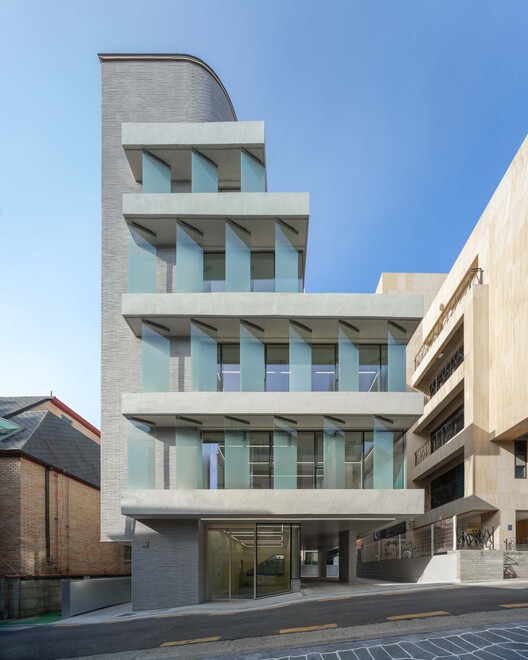
The Gap is the Tool
A four-storey height cap and a below-average Floor Area Ratio. That is the entire brief that Seoul’s Gangnam district hands to any architect working plot 169 on Nonhyun-ro — a corner site caught between a busy commercial spine and a quiet residential alley. See Architects, led by Kee Lew, delivered a 520 m² commercial building in 2025 that ArchDaily selected for its editorial programme precisely because the solution does not fight the constraint. It maps it.
←TODAY: Zoning envelopes across Seoul, Zürich, and Vienna are tightening — FAR reductions and height caps are the default tool for density management in 2026.
→3012: In the Zurich-3012 horizon, the performative envelope is the only envelope — regulatory geometry becomes generative code, not a ceiling to duck under.
Fulcrum: The insight that only works in both directions: constraint is not the opposite of design freedom; it is the coordinate system that makes meaningful freedom legible.
System: Why Corner Sites Are a Feedback Loop
A corner parcel creates two simultaneous public interfaces — the commercial street face and the residential alley face — with different scales, noise levels, pedestrian speeds, and visual expectations. Structural engineers SDM Partners and mechanical consultants Yousung Engineering both had to resolve systems across that dual exposure: lateral loads distributed differently on each axis, HVAC intake/exhaust positioned away from low-traffic residential windows. That is not a stylistic decision; it is a constraint cascade. Each regulatory line triggers a structural response, which constrains the façade strategy, which determines the programme distribution across four floors.
This is the system architecture beneath the photograph: zoning → structural grid → envelope → programme stacking → façade expression. Every step is a bottleneck that narrows the solution space, and every bottleneck is also, if read correctly, a filter that removes weak options before you spend money testing them. The AEC literature on constraint-led design — articulated clearly in research from ETH Zürich’s Chair of Architecture and Building Systems — consistently shows that tightly bounded envelopes produce higher spatial efficiency per square metre when the design team treats the regulatory geometry as the first parametric input, not an obstacle to route around.
Street: What This Means at Your Desk This Week
If you are working a Wettbewerb entry or a permit application under restrictive zoning — and in DACH that means almost every urban infill project right now — the Nonhyun 169 logic is directly applicable. Three moves:
- Map the regulatory envelope first, parametrically. In Grasshopper, a simple Ladybug-based solar envelope or a scripted FAR calculator turns the zoning PDF into a 3D solid you can subtract from, not a number you reference in a footnote.
- Name your dual interfaces explicitly. Nonhyun 169 has a commercial face and a residential face. Your site has analogues. Assign them different performance targets before schematic design, not after.
- Brief your structural engineer with the zoning envelope, not a floor plan. SDM Partners working from the envelope out is structurally more efficient than retro-fitting structure to a finished design. The PAZ BEP template used in our Cohort 12 BIM workflow exercises enforces this sequence as a project milestone gate.
Atelier: In PAZ parametric studio sessions, we treat the zoning envelope as Layer Zero — the first Rhino object on any urban project, locked and coloured red. Every subsequent design decision is a subtraction from that volume, not an addition to a blank site. Nonhyun 169 is a built proof of concept for that workflow sequence.
The Trade-Off, Plainly Stated
520 m² across four floors is small. Below-average FAR means the developer accepts lower leasable area in exchange for the corner location and the brand visibility it buys. That trade-off does not disappear because the architecture is elegant — it is the economic foundation the elegance rests on. Practitioners who present constraint-led design to clients without naming this exchange are setting up a conversation that will become difficult at the cost-per-square-metre stage.
Read the Nonhyun 169 project notes on ArchDaily, pull the SDM Partners structural credit as a reference for similar mixed-exposure corner briefs, and open your current urban infill project’s zoning ordinance. Model the envelope before you sketch a floor plan. That is the move.
SOURCE · ↗
PAZ Kaffi · multidisciplinary editorial, led by PAZ Academy
