
Tokyo's 100-Year Wooden House: What Happens When Compliance Is the Design Brief
Meguro Architecture Laboratory legalized a 100-year-old Tokyo wooden house—what AEC professionals in the DACH region can learn for existing-building mandates.
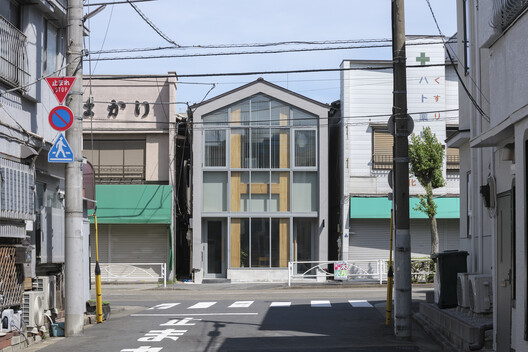
The House That Had to Legalize Itself
In Meguro, Tokyo, stands a wooden house that grew over a century through successive extensions and alterations—and in doing so, quietly became unpermitted construction. In 2025, Meguro Architecture Laboratory (leads: Mitsuru Hirai and Sayu Yamaguchi) completed the renovation and documented a project type far more common in Europe than professional literature admits: the house whose construction history matters more than its program.
The brief was clear and brutal: legalize first, then renovate. In practice, that meant three sequential steps—dismantling unapproved extensions, inserting a new foundation within the existing structural frame for seismic upgrade, and finally fire-compliant cladding. 148 m², one hundred years of building history, structured in three interventions.
←TODAY: Thousands of existing buildings in Zurich, Vienna, and Tokyo operate in a legal gray zone because extensions accumulated across generations without ever being fully re-evaluated.
→3012: In a world of complete digital building records, every subsequent alteration is automatically checked against the approved baseline—unpermitted construction as a category disappears, but the cost of dismantling remains.
Fulcrum: The systemic value of this house lies not in the outcome but in the documented sequence: compliance as design process, not afterthought.
Why This Project Type Matters Now
What Meguro Architecture Laboratory describes here is not an outlier—it’s a system failure endemic to dense urban fabric with aging timber stock. Tokyo has thousands of such structures. Japan’s Building Standards Act (最初の建築基準法 from 1950, revised multiple times) tolerated subsequent extensions for decades so long as no new permit was requested. Only when significant renovation begins does full compliance review trigger. The project is, as the architects themselves state, a «case study to explore possibilities for other timber structures under similar conditions»—rare candor in an industry reluctant to publish problem cases.
Structural engineer was Shimizu Structural Engineers—a significant detail. The new foundation had to be built within the existing timber frame without abandoning the house. This is no trivial problem: reroute load paths, maintain temporary bracing, meet seismic requirements, and coordinate removal of unpermitted sections. Per ArchDaily project documentation (2025), planning through completion took substantially longer than actual construction because of the submission process.
For PAZ readers in the DACH region, the transfer value is direct: Swiss cantonal building codes, especially sections on retroactive legalization in the Federal Spatial Planning Act (Raumplanungsgesetz/RPG) and cantonal building ordinances, include parallel mechanisms. Anyone taking on an existing building with accumulated extensions faces the same three-part sequence—dismantling, upgrade, compliance—before design work can begin.
Atelier: When you’re working on an existing-building mandate and the building record has gaps, your first deliverable isn’t a program—it’s a compliance-gap assessment: What’s approved, what was built, what must be removed or resubmitted? The Meguro project shows this sequence is documentable and thus replicable.
Name the System Risk
The honest caveat: Meguro Architecture Laboratory delivers a protocol, not a universal method. Seismic requirements in Tokyo are more specific and stringent than in most European contexts—inserting a new foundation in existing timber is not an option there but mandatory. In Switzerland or Austria, the triggers would be different, the sequence of interventions possibly reversed. The transfer value lies in the thinking pattern, not the technical specification.
What this project makes clear: the distinction between «design» and «compliance» is fiction in existing-building work. Design begins with building law, not after. Those who read that as a constraint lose time. Those who read it as process structure gain clarity.
Bring your next existing-building project in your office to this standard: How many of the existing extensions are fully permitted? The answer will reorder the entire project—before you draw the first floor plan.
SOURCE · ↗