

Building at the crater's edge: What the Santa María del Oro House teaches about resource-constrained architecture
What Mauricio Ceballos's crater-lake house teaches about execution gaps, local capacity, and context-aware BIM—for DACH architects.
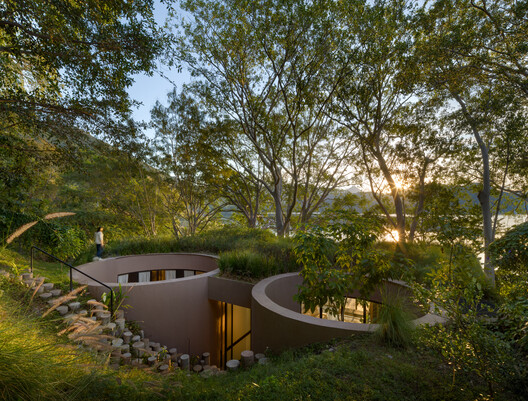
When the site becomes the system
A house. 250 m². Steep slope. Narrow street facade. Limited budget. And beside it: a crater lake in Nayarit, Mexico, whose ecosystem is so sensitive that every construction decision becomes a system question. This is the starting point of the Santa María del Oro House by Mauricio Ceballos X Architects (2022, photography: Rafael Gamo, via ArchDaily).
What makes this project interesting for PAZ readers is not the aesthetics—it is the system logic behind it. Four constraints act simultaneously: topography, infrastructure shortage, ecology, local craft capacity. Whoever optimizes only one of these parameters destroys another. This is not a Nayarit problem. It is a fundamental problem of architecture in resource-constrained contexts—and it affects more projects than we admit.
←TODAY: Swiss architecture offices are increasingly taking on projects in peripheral regions—mountain villages, border areas, densification in underserved communities—where infrastructure and craft capacity create similar bottlenecks.
→3012: In a future where material scarcity and climate risk reshape every building site, the ability to build with local capacity rather than against it is no longer a niche competence—it is a standard requirement.
Fulcrum: The true design parameter is not floor area or budget, but the transferability of external expertise into local execution.
Four constraints, one feedback loop
Ceballos’ office describes the challenge explicitly: «working with these conditions rather than opposing them»—and «generating opportunities for respectful collaboration that enrich local perspectives instead of imposing external design criteria incompatible with regional skills and resources» (project description via ArchDaily). This sounds like architectural philosophy, but it is a clear system statement: local execution capacity is a hard system boundary, not a soft preference.
The project makes visible something that often remains invisible in BIM-supported planning processes: the Execution Gap—the difference between what the model specifies and what local trades can actually build. In a project like this, you cannot close this gap with more detailed plans. You must calibrate the design system so the gap never arises in the first place.
Research from ETH-DFAB on on-site fabrication shows that local manufacturing capacity—not design complexity—is in most cases the actual project bottleneck. For digital fabrication on the ETH campus, that may be different. For Santa María del Oro, Nayarit, it is reality. And for surprisingly many Alpine communities in Switzerland as well.
What this surfaces
Concrete specifics: 250 m² usable area, construction year 2022, crater-lake ecosystem as environmental boundary, no stated structural system specification in the source—that is deliberate. The scarcity of published data is itself a signal. Projects in isolated communities often have no complete digital documentation. The question of how to define LOIN (Level of Information Need) for a context where the information basis is thin from the start is not a trivial BIM question.
For offices working in similar contexts—or preparing their processes for such contexts—there is a concrete system-mapping approach here:
- Constraints, before designing: Topography, local material availability, craft capacity, ecological limits—as input parameters, not as downstream conditions.
- Measure the Execution Gap early: What can local trades execute? What must be imported? Every imported solution is a risk point.
- Adapt documentation depth to context: A LOD-400 model is worthless if no one on-site can read it. LOD 200 with good working drawings in local language can accomplish more.
Atelier: In the PAZ course context—especially in modules on sustainable design methodology and context-aware BIM—the Santa María del Oro House is a clean case study for how to frame constraints as generative parameters rather than obstacles. Bring it into your next project review and ask: Where is our Execution Gap?
The crater-lake ecosystem is the hard ecological boundary of this project. Your next project has one too—maybe it is the groundwater protection area, monument preservation, or simply the capacity of a small contractor in a rural community. Map it first. Then design.
SOURCE · ↗
PAZ Kaffi · multidisciplinary editorial, led by PAZ Academy
