
Mud Brick at 20 Metres: What Earth Construction's African Revival Means for European Architects
HIVE EARTH at Sharjah 2026 and the Djenné mosque encode lessons Swiss architects need now. Here's the system behind mud brick's return.
A 4,000-Year Operating System for Building
The Western Deffufa in Kerma, Sudan, stands twenty metres tall and has been standing for four thousand years. It is mud brick. Not as a curiosity — as a load-bearing system that outlasted empires. As ArchDaily reported in April 2026, a new wave of African architects is treating earth not as a vernacular footnote but as a live technical proposition for contemporary construction. The signal is quiet but structurally significant.
←TODAY: Earth construction covers an estimated 30% of the world’s existing building stock (UNESCO / CRAterre figures), yet appears in fewer than 1% of European building permit applications.
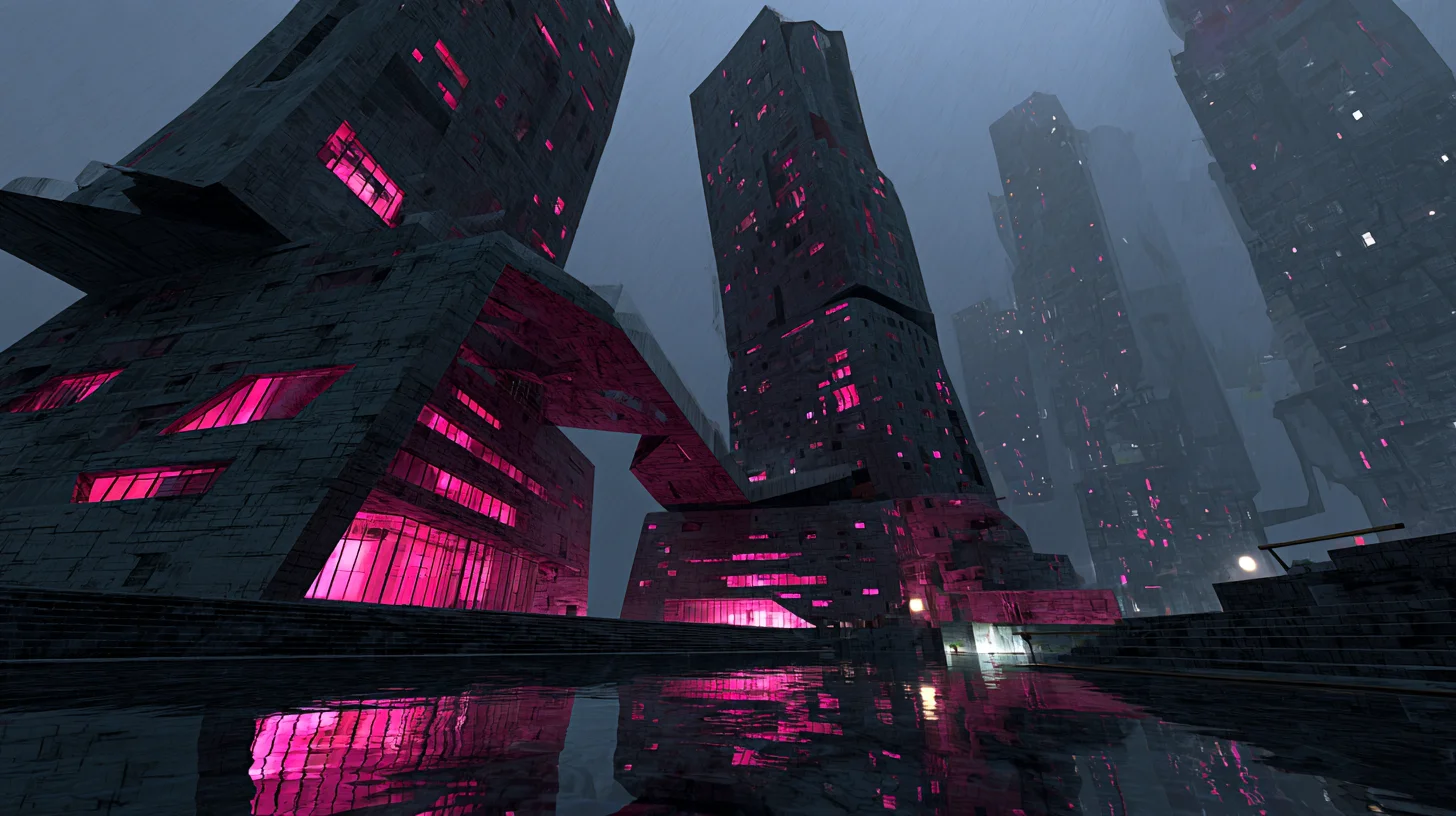
→3012: In a Zurich-3012 scenario where embodied-carbon accounting is mandatory and supply chains are shorter by design, rammed earth and adobe re-enter the structural palette not as nostalgia but as engineered defaults.
Fulcrum: The gap between those two data points is not a material problem — it is a knowledge-transfer and certification bottleneck.
The African cases ArchDaily documents are not monolithic. They are a system taxonomy. The painted earthen houses of Tiébélé in Burkina Faso demonstrate earth’s capacity as a surface substrate — soft enough for hand-applied decoration, precise enough for geometric patterning that doubles as waterproofing. Ghadames in Libya shows something more structurally ambitious: a composite of earth, lime, and palm trunks forming an interconnected urban fabric with covered streets and a walkable roofscape — passive cooling without mechanical systems. The Grande Mosquée de Djenné in Mali, the largest adobe building in the world, encodes its own maintenance protocol directly into the architecture: timber toron projections serve as permanent scaffolding for the annual community replastering cycle. The building knows it will degrade and accounts for it. That is systems thinking.
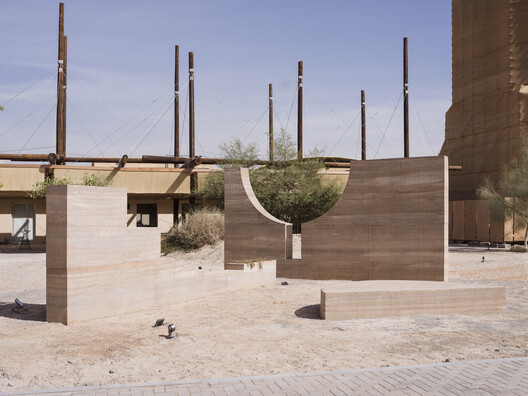
Why is this possible now and not ten years ago in European practice? Three shifts have converged. First, embodied-carbon regulation — EN 15978 life-cycle assessment is now embedded in Swiss SIA 2032 and Germany’s Gebäudeenergiegesetz revision cycle — creates a cost signal that compressed earth and rammed earth respond to extremely well, given near-zero process energy and full recyclability. Second, digital fabrication has removed the craft bottleneck: ETH Zurich’s DFAB HOUSE research and the broader robotic fabrication work at ETH Zurich’s Chair of Architecture and Digital Fabrication have shown that material irregularity can be handled algorithmically, not manually. Third, HIVE EARTH — the Ghanaian practice whose compressed earth block work appeared at the Sharjah Architecture Triennial 2026 — is publishing technical data, not just images.
On a working desk this week, the gap shows up in two places: specification and certification. Rammed earth walls do not have a clean SIA or DIN load table the way reinforced concrete does. The European standard EN 17137 (earthen construction — test methods) exists but is recent, lightly adopted, and not yet integrated into most Swiss cantonal building codes. That is the actual bottleneck, not the material’s performance. Djenné’s walls have been keeping a building interior cool without HVAC for centuries; the thermal mass and hygroscopic behaviour are well-documented in the CRAterre research database at the École nationale supérieure d’architecture de Grenoble.
Atelier: PAZ Academy’s materials literacy track treats earth construction as a live case study for the HIM (Holistic Integration Method) — specifically for the feedback loop between material behaviour, maintenance protocol, and lifecycle cost. A rammed-earth wall that needs re-sealing every decade is not a failure; it is a designed service interval. Architects who model that interval into their BEP at concept stage price it correctly.
The trade-off is real and worth stating plainly: earth construction is slower, wetter, and more sensitive to site-specific soil composition than concrete or timber frame. A wall that performs beautifully in Djenné’s Sahelian climate may require significant stabiliser additions — lime, pozzolan — in a Swiss alpine humidity regime, which partially erodes the embodied-carbon advantage. That engineering is solvable; it is not trivial.
The move: pull EN 17137 and the CRAterre technical sheets, then run a back-of-envelope embodied-carbon comparison against your next masonry spec using the KBOB 2024 data (Koordinationskonferenz der Bau- und Liegenschaftsorgane) published for Swiss LCA benchmarks. If the delta is what the Djenné case suggests it should be, bring it to your next Wettbewerb concept brief. The material is ready. The certification path is almost there. Start the conversation now.
SOURCE · ↗
PAZ Kaffi · multidisciplinary editorial, led by PAZ Academy
