
24 units, 2632 m²: What Igualada's affordable housing really says about Europe's housing crisis
4RQ and MBM Arquitectes build 24 affordable units in Igualada. What DACH architects can learn from this typology for their competitions.
Collective space as a system condition
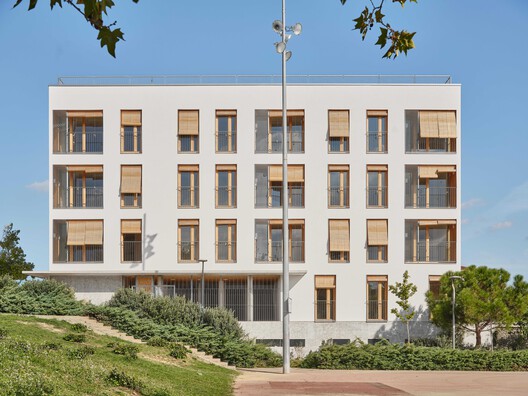
4RQ arquitectura and MBM Arquitectes have completed 24 subsidised housing units across 2632 m² in Igualada, Catalonia—completed 2025, photographed by Adrià Goula. It reads like a local footnote. But anyone reading the floorplan as a systems diagram sees something more fundamental: one of the few current European affordable-housing typologies that treats collective space not as remainder but as a design premise.
←TODAY: European cities—Vienna, Zurich, Barcelona—are wrestling in 2026 with vacancy rates below 1% in the subsidised segment while construction costs climb past CHF 4,500/m².
→3012: Within the Zurich-3012 horizon, the question is no longer whether collective space is profitable, but which governance models keep it viable in operation.
Fulcrum: The decision to treat shared space as a planning premise rather than a cost-saving option is not an aesthetic question—it is a systems-architecture decision.
The project sits in a mid-sized Catalan city of roughly 40,000 residents—no Barcelona showcase, no ETH-DFAB experimental build, but a routine public commission. That’s precisely what makes it instructive. The housing design comes from Marta Camañes, Oriol Capdevila, and Gerard Torrent (4RQ), with technical team Beth Bacardit and Santi Velasco, under the roof of the historic practice MBM Arquitectes—founded by Martorell, Bohigas, and Mackay, the Catalan urbanism trio who shaped Barcelona’s public spaces in the 1980s. This genealogy is not trivia: it explains why the practice understands collective space as a systems parameter, not a bonus.
The systems problem behind the project
Post-war European affordable housing faced a classic feedback-loop problem: communal spaces were planned but not managed—lacking governance, budget, or usage model. The result was the familiar pattern: empty foyers, neglected courtyards, social decay. What 4RQ and MBM do differently here—insofar as project description and photo documentation tell—is a floorplan logic that programmes collective thresholds and in-between spaces as active zones, not as circulation.
This is systemically relevant because it rewrites the cost-benefit math: more collective space means higher per-unit area in the short run—2632 m² across 24 units yields roughly 110 m² gross per unit, which is ambitious in the subsidised sector. According to the European Housing Observatory (2024), the EU average for social housing is 70–85 m² net per unit; the gross uplift for communal space decides whether the overall model pencils out.
For Swiss and DACH-region practitioners, the context is familiar: housing co-operatives in Zurich—like Genossenschaft Kalkbreite or Mehr als Wohnen—operate on a similar premise: collective space as a productive factor, not as a residual. The difference in Igualada is the financing structure: public tender, not a co-op model, but comparable spatial ambition.
Atelier: Practitioners working on housing competitions in the DACH region should use the Igualada project as a reference point for justifying communal space allocations in cost estimates—not as a design template, but as a systems argument: collective space lowers long-term operating costs when planned with a usage programme. It’s an argument you can quantify before clients and juries.
What the system still doesn’t solve
The honest assessment: a completed building doesn’t yet prove a functioning social-space system. Adrià Goula’s photo documentation shows architecture, not use. Whether communal spaces will still be active in five years depends on factors no floorplan alone controls: building management model, tenant composition, municipal support. It’s the familiar failure mode in affordable housing—well designed, poorly operated.
For practitioners, that means: the project is a valid typological building block but not a finished operating model. Anyone incorporating it into their own competition submissions or BEP structures should address the governance question explicitly—preferably in the spatial programme itself, not just in operational planning.
Concrete next step: pull the project data from the ArchDaily documentation (Adrià Goula, 2025), compare the gross-to-net ratios against the ETH Wohnforum dataset on Swiss social housing, and bring the question—What share of collective space does our programme justify?—into your next competition-prep meeting.
SOURCE · ↗