
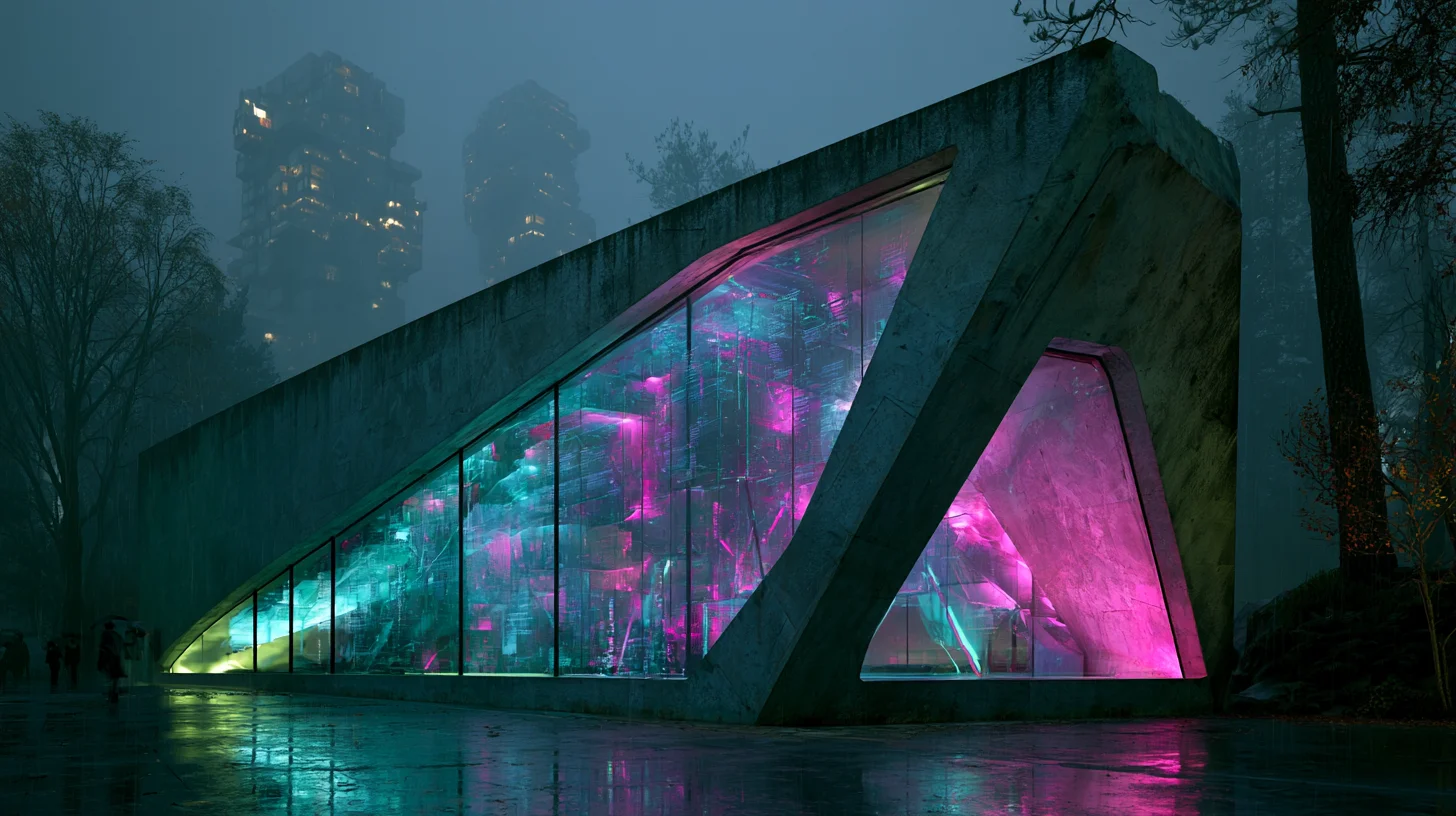
54,690 m² Civic Stack: What GL Studio's Yutang Center Teaches About Mixed-Use Systems
GL Studio's 54,690 m² Yutang Center in Shenzhen is a systems-design case study in mixed-use civic integration — with direct lessons for DACH competition briefs.
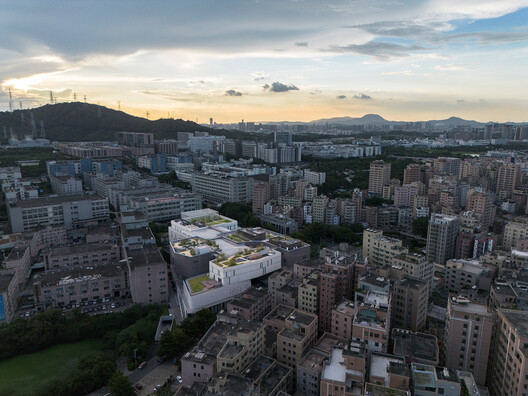
One Slab, Eight Programs, Zero Slack
When GL Studio — the design arm of Shenzhen University’s Institute of Architecture Design & Research — completed the Yutang Culture and Sports Center in 2025, they shipped something worth studying beyond the photography: a 54,690 m² civic machine that stacks sports hall, library, cultural center, art gallery, performance space, community health clinic, bus terminal, and retail into a single integrated complex in Guangming District, Shenzhen. As ArchDaily reported this month, roughly 29,000 m² sits above grade and 25,690 m² below — an almost even split that signals a deliberate strategy, not an afterthought.
←TODAY: Most European civic briefs still separate sport, culture, and transit into standalone buildings with separate Bauleitung contracts and siloed MEP systems.
→3012: The Zurich-3012 horizon treats the civic complex as a single adaptive organism — one data spine, shared envelope loads, programs that borrow capacity from each other in real time.
Fulcrum: The Yutang section drawing is not an aesthetic choice; it is an argument about shared infrastructure that European procurement rules have not yet learned to write.
Why This Is Possible in 2025 and Not 2010
Three conditions converged. First, Shenzhen’s urban-village renewal cycle created a client — the Public Works Bureau of Guangming District — willing to consolidate what would normally be five separate procurement packages. Second, structural engineering capable of spanning the load differentials between a sports hall (high live loads, long spans) and a library (moderate loads, cellular planning) in the same building envelope has become routine in Chinese practice, as documented in the China Academy of Building Research’s facade and structural guidelines that served as technical backstop here. Third, BIM-enabled coordination at this program density — the design team alone lists sixteen named contributors plus a separate twelve-person engineering cluster — is only tractable when the model is the contract, not a deliverable alongside it.
The below-grade figure is the tell. 25,690 m² underground means the bus terminal and most of the parking and service infrastructure disappear from the street, leaving the above-grade volume available for civic frontage. That is a sectional decision with urban-planning consequences: the surrounding Tianliao Community gets a legible public face rather than a service yard.
On Your Desk This Week
If you are working on a mixed-use competition brief — and in the DACH market, Wettbewerb briefs for combined Kultur- und Sportzentrum typologies are increasing as municipalities consolidate post-COVID budgets — the Yutang section repays close reading. The failure mode in European mixed-use is program segregation disguised as zoning compliance: each function gets its own stair core, its own MEP riser, its own facade zone. The building looks integrated in the render and operates as five adjacent buildings in practice. GL Studio’s engineering team (listed separately from the design team, which is itself a signal of genuine technical depth) addressed structural continuity across the sports-hall span and the finer-grain library grid — a problem that typically kills integration at schematic design stage when the structural engineer arrives late.
The trade-off worth naming plainly: a building this programmatically dense is almost impossible to phase or partially occupy. If the bus terminal fit-out delays, the whole ground-floor activation strategy stalls. European clients used to phased handovers should model that risk explicitly before adopting the typology.
Atelier: In PAZ’s HIM (Hybrid Integration Methodology) framework, Yutang reads as a Level 3 civic stack — shared structural grid, shared envelope, shared below-grade infrastructure, but independent operational management per program. When you next define a LOIN for a mixed-use competition, add a column for shared-infrastructure dependencies alongside the standard room-by-room schedule; it forces the conversation about who owns the bus terminal’s MEP riser before the competition jury, not after the building permit.
The System Behind the Image
Facade consultant China Academy of Building Research and lighting consultant DASUN Environmental Art both appear in the credits — late-stage consultants whose involvement at this scale suggests the envelope is doing acoustic and thermal work across very different interior profiles simultaneously. A sports hall and a library share almost no HVAC logic: peak occupancy timing differs, acoustic separation requirements differ, fresh-air loads differ. The facade is the mediating layer. That is a systems-design problem before it is an aesthetic one, and it is where European AEC teams typically under-resource the consultant brief.
Pull the GL Studio project into your next team review not as inspiration but as a checklist: Which of our eight programs share structural grids? Which share MEP risers? Where does the section force a decision that the plan is hiding? Start there.
SOURCE · ↗
PAZ Kaffi · multidisciplinary editorial, led by PAZ Academy
