

Flood-Calibrated Architecture: Why Reversibility Outperforms Resistance When Water Returns Every Year
Khudi Bari, Ganvié, amphibious houses: PAZ maps the structural logic behind flood-calibrated architecture and what it means for DACH practice today.
The Water Returns — The Question is How You Built
Flood maps treat inundation as a failure event. In the Brahmaputra basin, the Mekong Delta, and across the floodplains of Bangladesh, it is a calendar entry. Architecture that ignores this distinction does not fail dramatically — it fails predictably, repeatedly, and expensively. A piece published on ArchDaily by Ananya Nayak (April 2026) assembles several built cases that reframe the design brief entirely: not how do we keep water out, but how do we build something that works when water is in.
←TODAY: The Asian Development Bank and World Bank both report that in flood-prone regions, recovery time matters more than peak damage resistance — yet most building codes still optimize for threshold resistance, not continuity of use.
→3012: In a Zurich-3012 scenario where the Limmat basin sees 40-year flood events become 8-year events, the amphibious foundation detail stops being a curiosity and enters the standard Leistungsverzeichnis.
Fulcrum: Reversibility is not a compromise on quality — it is a different performance specification, one that current SIA norms are not yet written to reward.
System Architecture: Lightweight, Modular, Repairable
The cases Nayak cites share a structural logic worth mapping as a system. Three inputs define it:
- Material weight: Low dead load means lower hydrostatic force during inundation and easier relocation. Marina Tabassum Architects’ Khudi Bari housing system in Bangladesh uses a lightweight bamboo frame with joints designed explicitly for disassembly — every connection anticipates a future moment of unbuilding.
- Buoyancy as a structural mechanism: H&P Architects’ Floating Bamboo House uses recycled barrels as pontoons, allowing the floor plate to rise with water level. Occupation continues during inundation. This is not flood resistance; it is flood compatibility.
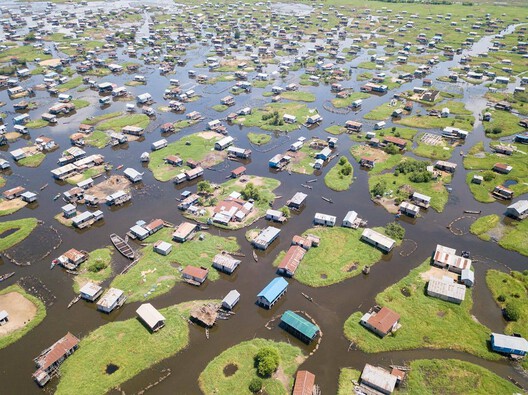
- Settlement-scale logic: Ganvié, the stilt village built over a lagoon in Benin, demonstrates that when the pattern scales to an entire settlement, water circulation becomes infrastructure. Boats replace streets. The system does not defend against fluctuation — it is structured by it.
The feedback loop here is important: lightweight and modular systems fail incrementally rather than catastrophically. A joint fails, a panel floats away, a barrel needs replacement — each event is local and repairable. Heavier, more rigid construction is engineered to a threshold; exceed that threshold once and recovery is prolonged and expensive. Per World Bank analysis cited in the ArchDaily piece, resilience in flood-prone territories correlates more strongly with reduced recovery time than with damage prevention.
The Limits of Engineering Logic
CTA Creative Architects’ amphibious houses push the logic further with buoyant foundations and vertical guideposts — structures that rise in place as water rises around them. More precise, more repeatable. Also: harder to maintain locally, dependent on manufactured components, and increasingly opaque to the communities using them. This is the trade-off the article names plainly and that practitioners in DACH contexts should hold: as a flood-adaptive system gains engineering complexity, it risks losing the local repairability that gave it resilience in the first place. A system you cannot fix yourself is only as resilient as your supply chain.
The deeper problem is taxonomic. Anthropologist William Balée’s work on culturally modified landscapes is invoked in the ArchDaily piece to make a pointed analogy: systems that look informal are often the product of long-term, highly intentional design intelligence. A bamboo joint calibrated for annual disassembly is not a primitive detail — it is a precise one. When institutional frameworks standardize these systems, they tend to fix what was designed to be variable, redefining resilience as endurance rather than adaptability.
Atelier: In a PAZ studio context, this is a parametric brief problem: design the disassembly sequence before you design the assembly. If your Grasshopper model cannot simulate the reverse build — joint-by-joint, panel-by-panel — you have not modeled the system’s most important performance criterion. Run the teardown logic first.
What This Means for Your Practice
Swiss and German practice rarely encounters annual inundation at this scale, but the underlying systems question transfers directly to any context where ground conditions are not fixed — whether that is a Basel floodplain, a coastal reclamation project, or a temporary Pavillon that needs to be buildable and unbuildable by the same local crew. The SIA 261 load standard gives you hydrostatic pressure calculations; it does not give you a reversibility metric. That gap is worth naming in your next BEP.
Read Nayak’s full piece on ArchDaily alongside the PAZ Climate Adaptation module framing, then bring one concrete question to your next team meeting: at which water level does our current detail fail, and how long does recovery take from that failure mode?
SOURCE · ↗
PAZ Kaffi · multidisciplinary editorial, led by PAZ Academy
