

HarPie: What a Narrow Lakeshore Strip in Quebec Teaches About Site-Driven Section Logic
What Nathalie Thibodeau's HarPie house in Quebec teaches architects about section-driven site logic — and how to apply it on Swiss lakeside terrain.
Terrain als Taktgeber
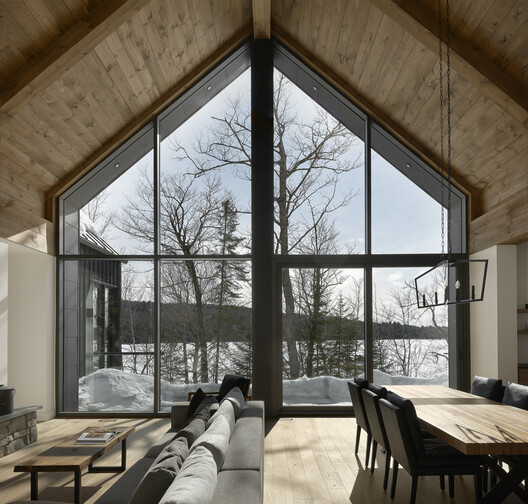
Nathalie Thibodeau Architecte’s HarPie residence (Wentworth, Quebec, 2025) is a 6,350 ft² house squeezed between a lakeshore and an access road. That constraint is the whole design. The architects didn’t fight the pinch — they ran a section through it, used the natural slope to separate public approach from private living, and oriented every significant glazed surface toward the water. The photographs by Maxime Brouillet, published on ArchDaily, show what that decision looks like in practice: a calm, stratified interior where the lake reads as a room without a ceiling.
←TODAY: Narrow infill and riparian plots are increasingly the only buildable land left in desirable Swiss and Canadian lakefront municipalities — zoning pressure is tightening on both sides of the Atlantic.
→3012: In a Zurich-3012 scenario of extreme land scarcity, section-driven site logic isn’t a stylistic choice; it’s the primary design algorithm.
Fulcrum: The slope is free geometry — the only question is whether you read it as constraint or as structural argument.
System: Why Section-First Still Works
Site-responsive design sounds obvious until you watch how many residential projects default to plan-first organisation and treat section as a derived consequence. HarPie reverses that order. The slope on a narrow strip between road and water creates a natural datum: road level at the top, lake level at the bottom, habitable space threaded between. That hierarchy — openness toward water, opacity toward road — is not decorative. It resolves daylighting, acoustic privacy, and visual access in a single move.
This is the same logic behind ETH Zurich’s recurring studio briefs on lakeside residential typologies, where students are pushed to work in section from day one rather than retrofitting height changes onto a completed plan. The reasoning is identical: when the datum shifts vertically across the site, the section is the primary generator. Lead architect Nathalie Thibodeau, with technical lead Mathilde Hamel and project lead Simon Isabelle, executed this without visible drama — which is exactly the point.
Street: What This Means at Your Desk
If you work in a firm handling vacation homes, lakeside villas, or any residential brief on sloped terrain in the DACH region — think Vierwaldstättersee, Bodensee, or the Bernese Oberland — HarPie is worth a close read before you open your next section drawing. The specific moves to note:
- Threshold differentiation by level: entry and service functions absorb road-level exposure; living areas drop to the lower datum where the view corridor opens unobstructed.
- Landscape as partition: the slope itself screens the living floor from the road, reducing the need for built screening elements that would otherwise eat into the floor plan.
- A single orientation rule applied consistently: water-facing glazing, road-facing mass. Simplicity that holds under contractor and client pressure alike.
The trade-off is real: section-first design commits the vertical organisation early, which makes late-stage plan rearrangements expensive. If your client’s programme shifts mid-schematic, a slope-dependent section hierarchy is harder to negotiate than a flat-site plan. Know this going in.
Atelier: In PAZ Academy’s residential site-analysis modules, we frame the slope as a constraint that offers before it demands: map what the terrain gives you in section before testing any plan configuration. HarPie is a clean built example to anchor that conversation — 590 m², one site rule, no wasted moves.
Move
Pull the ArchDaily project page for HarPie, open the Maxime Brouillet section photographs side-by-side with your own current site section, and ask one question: where is my natural datum, and is my plan organised around it or despite it? If the answer is «despite» — that’s your next design iteration.
SOURCE · ↗
PAZ Kaffi · multidisciplinary editorial, led by PAZ Academy
