

Hennebont's 17-Metre Equestrian Hall: What K architectures Got Right About Contextual Insertion
K architectures' 17m equestrian hall at Hennebont shows how regulatory constraints shape form — and what BIM teams can learn from it.
Read what the building says — before you respond
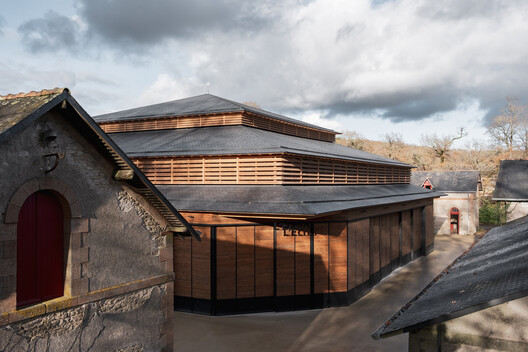
In 2025, K architectures completed a 1,464 m² equestrian performance hall inside the Cour du Puits at the Hennebont National Stud Farm (Haras National de Hennebont), Brittany. The structure rises seventeen metres — visibly above the Napoleonic-era longère stables — yet the design team’s stated move was not contrast but resonance. That distinction is worth unpacking for any AEC professional working in heritage-sensitive contexts.
←TODAY: Roughly 40% of European construction volume touches existing built fabric, per Eurostat 2024 renovation data — heritage insertion is the default condition, not the exception.
→3012: In the Zurich-3012 horizon, the question is no longer whether to preserve but which data layers of a site carry irreplaceable signal, and how parametric form-finding is trained to read them.
Fulcrum: The insight that makes both directions legible: formal language is a protocol — you choose it deliberately or you inherit it by accident.
The System Behind the Decision
French heritage law (the Loi sur les Monuments Historiques and the associated ZPPAUP/AVAP frameworks) creates a layered approval environment: any intervention near a classified or inscribed site passes through the Architecte des Bâtiments de France. That structural constraint alone explains why the lead architect Margaux Alépée and the K architectures team ruled out a transparent glass-and-steel pavilion — not purely on aesthetic grounds, but because the approval path for an “anachronistic contemporary gesture” in a site carrying Napoleonic-era buildings would have been longer, costlier, and less certain. Structural studies were handled by EVP Ingenierie; technical coordination by AREA études. The material palette — slate roofline, traditional massing — is partly a regulatory output as much as a design intention.
This is a useful systems observation: in heritage contexts, the regulatory graph shapes the formal solution space before the first sketch is pinned. Understanding that graph is as important as Grasshopper fluency.
What This Looks Like on Your Desk This Week
The Hennebont hall sits in a category that BIM workflows often handle badly: historically sensitive new-build insertions. The geometric deliverables are straightforward — 1,464 m², one main volume, clear-span structural grid for equestrian use. But the model’s real complexity lives in the site-context data: existing cadastral boundaries, sight-line envelopes defined by the classification perimeter, roof pitches and ridge heights of the adjacent longères that become soft constraints on massing.
In practice, this means your BIM model should carry the historic fabric as live linked geometry (even a simplified LOD 200 mesh), not as a static background DWG. If you work in Archicad, its native Hotlink Manager — scriptable through the Python/JSON API — makes this significantly less painful. If your team is on Revit, the same principle applies via linked models with visibility filters locked to the heritage layer. The payoff: every massing iteration is immediately legible against the protected context, and you have an audit trail for the Baubehörde or its French equivalent.
As ArchDaily’s project record notes, the manufacturers list for Hennebont spans nine firms — CULAUD, FRANCE TRIBUNES, GLC, LAUTECH, MAHO, Pigeon, SPECTACULAIRES, SPIE, TALLOT — a coordination load that only works with a clean model environment from the start.
Atelier: In PAZ’s BIM Coordination courses, we frame heritage insertion as a constraint-first modelling exercise: before massing begins, map the regulatory envelope as a solid, subtract it from the allowable volume, and only then explore form. Hennebont is a clean real-world example of that method producing a building that reads as inevitable rather than imposed.
The Trade-Off, Plainly Stated
Choosing “classical vernacular to resonate with the soul of the place” — K architectures’ own framing — carries a risk that is worth naming: vernacular mimicry can slide into pastiche. The seventeen-metre height and the programme (contemporary equestrian performance, not historic stable use) are the elements that prevent that slide here. The volume is frankly large and modern in scale; the formal language simply avoids aggression. That calibration is hard to encode in a design brief — it lives in judgment, not in a BIM template. Know the difference.
If you have a heritage insertion on your board right now, pull the regulatory envelope first, load the historic context as live linked geometry, and only then have the formal-language conversation with your team. Hennebont is a good reference point for that conversation.
SOURCE · ↗
PAZ Kaffi · multidisciplinary editorial, led by PAZ Academy
