
ISS CRS-24: What a Falcon 9 cargo flight reveals about robotics and quantum research in orbit
What the Northrop Grumman CRS-24 cargo flight to the ISS reveals to architects and BIM engineers about robotics, constraints, and resilience.
Orbit Logistics as Systems Test
On 11 April 2026, the Northrop Grumman CRS-24 mission launched — a Cygnus XL capsule named S.S. Steven R. Nagel, carrying roughly 4,990 kilograms of cargo, aboard a SpaceX Falcon 9 from Space Launch Complex 40 at Cape Canaveral. For many, this is routine logistics. For anyone building systems that must function under constraints — architects, BIM engineers, robotics developers in the AEC space — CRS-24 is a precise mirror: How do you orchestrate data, hardware, and autonomy in a closed, failure-critical environment?
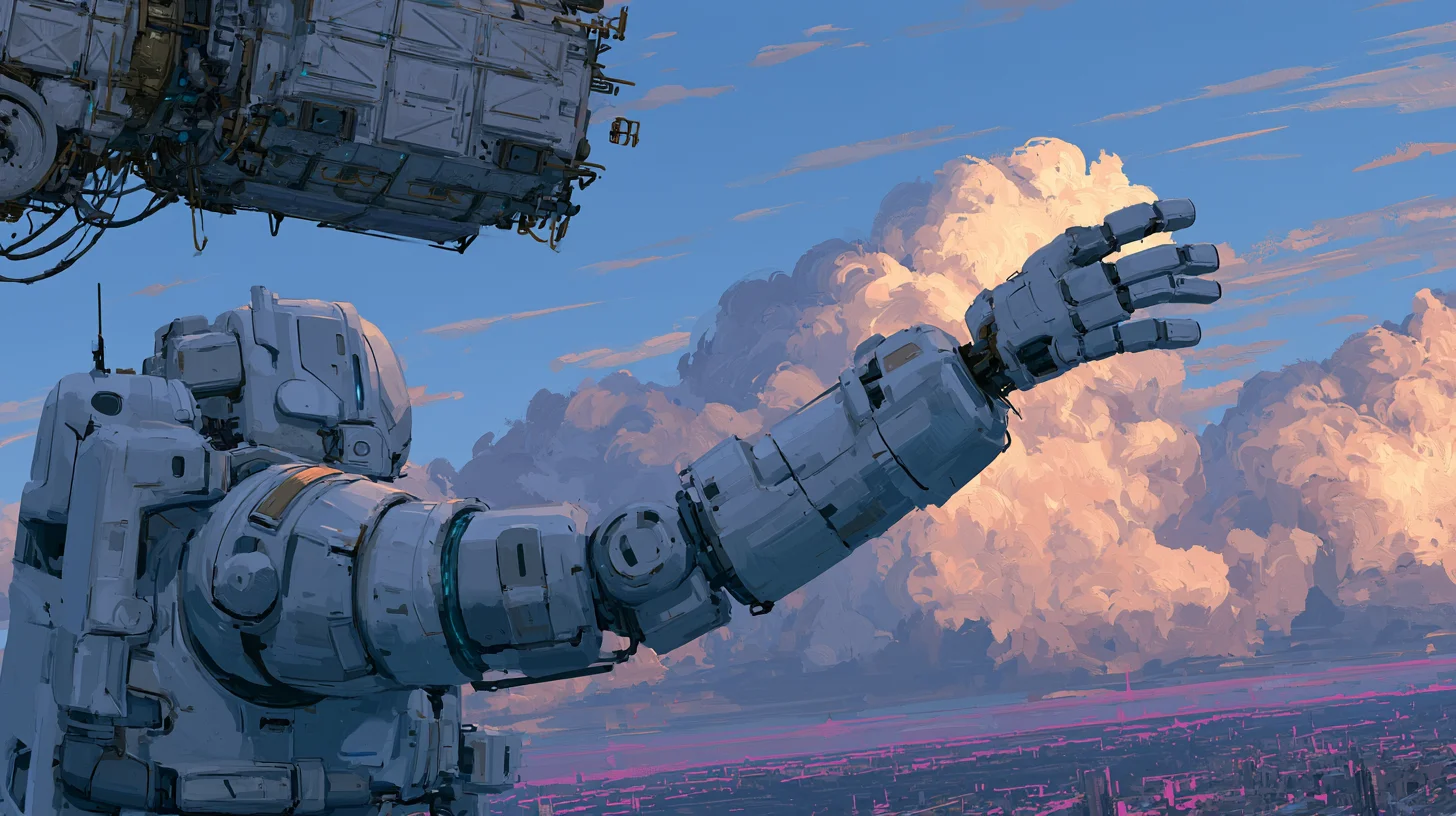
←TODAY: Cygnus XL docks at the ISS on 13 April 2026 via Canadarm2 — a kinematically defined grapple at 400 km altitude and 27,600 km/h.
→3012: In Zurich-3012, adaptive robotic grippers will translate that same constraint logic into fully automated construction assembly — no hands at the controls, but the same fault-tolerance architecture.
Fulcrum: The Canadarm2 grip is today’s model, tomorrow’s standard — whoever understands the kinematics builds better digital twins.
The System Behind It
CRS-24 is not a one-off event but a node in a multi-layered supply chain: SpaceX provides the launcher, Northrop Grumman the capsule, NASA coordinates payload and schedule. The Cygnus XL architecture is deliberately passive — it cannot dock on its own but is captured by the Canadarm2, a 17.6-meter robotic arm with seven degrees of freedom operated remotely by NASA astronauts Jack Hathaway and Chris Williams. This is not detail: it is a deliberate design choice that shifts complexity from the capsule to the stationary infrastructure — a principle directly applicable to building automation and robotic construction.
Per NASA press release (Release 26-031, 11 April 2026), the mission carries dozens of experiments, including a quantum science module intended to improve computational architectures and aid the search for dark matter, as well as hardware for producing therapeutic stem cells. Another payload: a receiver to improve space weather models — GPS protection as a systems-resilience problem, not as astronomical exotica.
What This Means for Your Desk
Three systems features of CRS-24 that translate directly into AEC practice:
- Constraint-first Design: Cygnus XL has no docking thrusters of its own — that reduces weight but shifts complexity to Canadarm2. In BIM: the less intelligence in the component, the more in the connection protocol. Whoever defines LOD and LOIN makes the same choice.
- Long window, defined end: The capsule stays at the ISS until October, then burns up on reentry with tons of debris. Lifecycle management with a fixed disposal plan — what architects can learn for deconstruction scenarios and material loops.
- Redundant data streams: The space weather receiver onboard protects GPS and radar — critical infrastructure that site drones, surveying equipment, and BIM coordination apps all depend on. A failure cascades down the process chain from orbit to ground.
The ETH-DFAB Lab in Zurich has been working for years to translate similar constraint hierarchies into robotic assembly — from fabrication in the robotic arm to in-situ assembly on site. The parallels to Canadarm2 logic are not metaphorical but kinematically concrete.
Atelier: Anyone modeling robotics workflows in a PAZ course or own BIM project should treat the Canadarm2 capture sequence as a reference case for kinematic constraint hierarchies: Where does the intelligence live — in the gripper or the grasper? This question structures every robotics deployment in the building process.
What You Can Do Now
Study the Canadarm2 documentation from the Canadian Space Agency — it is public and technically detailed enough to serve as a reference for robot end-effectors in Grasshopper simulations. Then ask your team a simple question: Which of our process steps implicitly depend on GPS accuracy — and what breaks if that signal degrades? Systems resilience begins with an inventory of dependencies.
Source: NASA Breaking News
SOURCE · ↗
PAZ Kaffi · multidisciplinary editorial, led by PAZ Academy
