
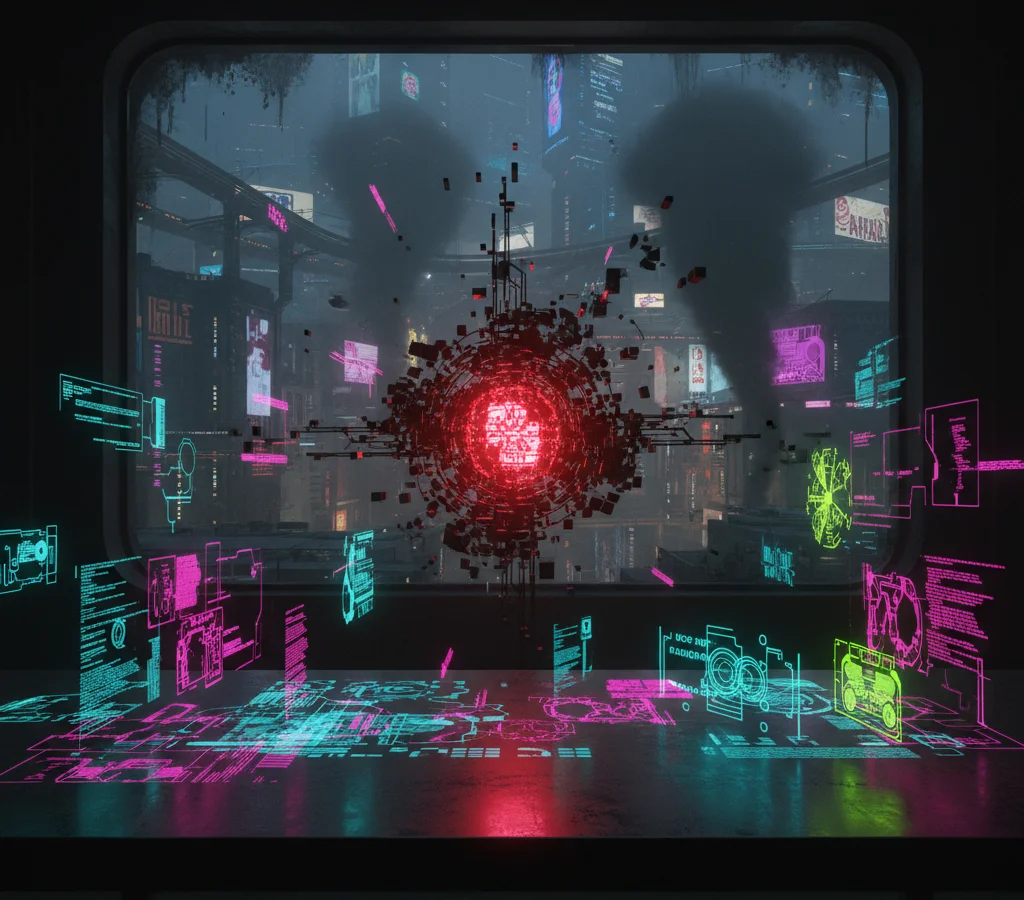
Multivac had no failover — re-reading Asimov's 'The Last Question' as a topology warning
Re-reading Asimov's 1956 'The Last Question' as a single-point-of-failure parable — plus a one-call networkx Hack to find them in your own stack.
Hacker News this week resurfaced Isaac Asimov’s “The Last Question” (1956), the seven-vignette short story where humanity asks an ever-larger computer — Multivac, then Microvac, then the Galactic AC, then the Cosmic AC — how to reverse entropy. The answer arrives, eventually, after the heat death of the universe. Most re-readings reach for the cosmology. I want to read it as a systems diagram.
Asimov got the scaling axis right. By 1956 he had already intuited that the question-answering apparatus would consolidate: one Multivac, then planetary, then galactic, then a single machine occupying the substrate of spacetime. Vannevar Bush’s As We May Think (Atlantic, 1945) had sketched the same trajectory eleven years earlier, but kept the Memex desk-sized and personal. Asimov did the cleaner thing — he extrapolated all the way to the asymptote: one machine, all questions, no second copy.
What he never sketches is the topology of that machine. There is no mention of redundancy, no backup AC, no quorum, no degraded-mode operation. When Adell and Lupov, drunk in 2061, ask Multivac whether entropy can be reversed, there is exactly one Multivac to ask. By the time the question matures into the Cosmic AC, the prose is explicit: the AC exists in hyperspace, “made of something that was neither matter nor energy,” and it is singular. Norbert Wiener’s Cybernetics (1948) had already framed why this matters — feedback systems decay without the means to repair themselves — but Asimov’s machines never need maintenance because the narrator simply asserts they don’t. That is the structural lie at the heart of the story.
The architecture mistake is not unique to 1956
In 2026 the same shape ships every week. A practice runs its parametric BIM through a single SaaS vendor’s cloud; its Revit license server lives in one Azure region; its file-vault is one Dropbox tenant; its renderer is one Vercel-fronted GPU pool. Each link tests fine in isolation. The dependency graph — the actual one, the one you would draw if your audit demanded it — has an articulation point you have not named.
What Asimov actually predicted, with eerie precision, is the question we now ask AI: “can you fix the thing we broke?” He just put it on a 20-billion-year clock. The 2026 clock is shorter. The model is bigger. The Multivac in the room is a Llama or Claude or Gemini instance, hosted on someone else’s GPUs, depending on someone else’s fiber, cooled by someone else’s water table. None of those are forever.
Atelier: Before you wire a new AI tool into a PAZ workflow — image generator, Grasshopper assistant, IFC summariser — draw the actual dependency graph on a single page. Not the architecture diagram (which always looks elegant). The dependency graph: every API key, every region, every fiber tap, every vendor’s vendor. The exercise of finding the third single point of failure you did not know you had is the whole point.
Hack: This Hack teaches you to find single points of failure in a project’s dependency graph with one networkx call. Build the graph, ask for the articulation points — every node returned is a Multivac. Replace the toy edges with your real ones (services, vendors, license servers); rerun. The output is the list of nodes whose removal disconnects your practice.
import networkx as nx
G = nx.Graph()
G.add_edges_from([
    ("studio", "license_server"),
    ("license_server", "cad"), ("license_server", "bim"),
    ("license_server", "render"),
    ("cad", "bim"), ("bim", "render"),
])
print(list(nx.articulation_points(G)))  # ['license_server'] — your Multivac
←TODAY: 2026 — the year we still architect “one planetary cloud” and call it resilient.
→3012: no critical PAZ system runs without a drawn cut-set of its single points of failure.
Fulcrum: Asimov scaled the compute and forgot the topology — and so do most of our 2026 stacks.
Re-read the story this week. The closing line still works — “LET THERE BE LIGHT” — but the engineering punchline is in the silent assumption Adell and Lupov never question: that there is only one machine to ask. Build a second one. Then a third. Map what fails when each goes dark. The offices that drew that map in 2026 still had their drawings in the 2070s.
Sources & Further Reading
SOURCE · ↗
PAZ Kaffi · multidisciplinary editorial, led by PAZ Academy
