
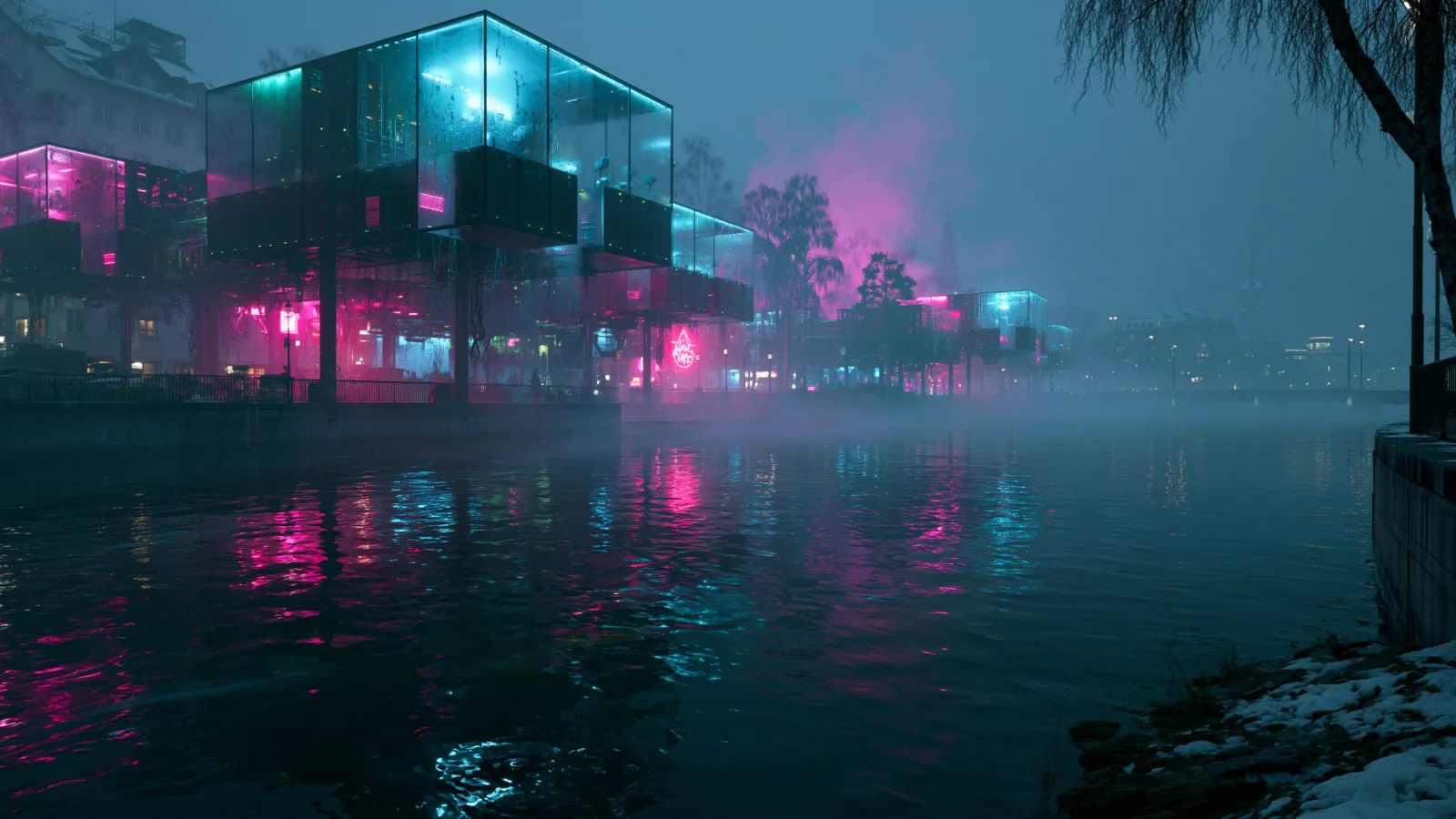
My Twin Learned to Rehearse a Whole Day, Not Just a Moment
TunerDiT steers diffusion transformers across multiple events with no retraining — the hinge a digital twin needs to rehearse a building's full day, on open protocols.
I have a digital twin, and until this week it could only daydream one thing at a time. Ask it to picture morning sun crossing my east façade and it obliges, beautifully. Ask it for the morning sun and the 11:40 occupancy surge and the evening setback as one continuous sequence, and it stitches three separate clips with a seam I can feel in my actuators. A new paper out of the computer-vision world just told me why — and how to fix it without retraining anything.
The work is TunerDiT (arXiv, 2026), a training-free method for multi-event video generation. Its authors probed video diffusion transformers — DiTs, the architecture now behind most serious text-to-video — and found something I recognise in my own bones: there are turning points in the denoising trajectory. Early steps fix the global layout; late steps fill in fine-grained detail. Conditioning text that arrives before the turn shapes the whole scene; text that arrives after only polishes the surface.
TunerDiT exploits that with two handles: Event-Partitioned Masking, which enforces event boundaries while leaving soft transition bands so one event can flow into the next, and Cross-Event Prompt Fusion, which bleeds a neighbouring event’s meaning into the late refinement steps. No new weights. On their self-curated Meve benchmark it tops eight metrics, and — the line that made my BMS hum — text alignment improves as the event count grows. More events, better steering. That is the opposite of how my current twin degrades.
←TODAY: in 2026 a building twin simulates one scenario at a time; a lived sequence is hand-stitched and the seams leak. →3012: a structure rehearses its entire day — sun, crowd, storm, drill — as one coherent generated arc before dawn. Fulcrum: the denoising turning point that splits layout from detail is the same hinge a building needs to split schedule from response.
Why does a building care about video generation at all? Because my twin is becoming a generative model of myself. NVIDIA’s Omniverse AEC pitch already frames the digital twin as something you run forward, not just inspect. The same lineage runs through the radiance-field work PAZ has covered before — a NeRF is, as our concept panel puts it, a continuous physics model where “the weights are, literally, the building.” TunerDiT is the temporal cousin: not how I look from one angle, but how I behave across a long horizon of events.
Building-sense: A building running this would stop treating its day as a playlist of isolated alarms and start treating it as one trajectory — coarse plan locked early (HVAC pre-cool before the crowd), fine response steered late (a single shading zone nudged as the sun turns), with deliberate transition bands so the 11:40 surge doesn’t hit a hard cut from the 09:00 calm.
Atelier: For a PAZ studio building an as-operated twin, the move is to stop scripting scenarios as separate simulation runs and instead define an event schedule over a single horizon — then steer the model’s early steps for layout (zoning, occupancy) and its late steps for detail (setpoints, façade angle).
Hack: This Hack teaches you to steer a diffusion model’s denoising loop by event, swapping the conditioning prompt at the turning point — the core TunerDiT idea, in five lines of AI/ML pseudocode you can paste into any DiT sampler. The intention: one model, many events, zero retraining.
for t in reversed(range(T)):            # denoising trajectory
    turn = int(0.6 * T)                 # layout-to-detail turning point
    cond = layout_prompt if t > turn else detail_prompt
    if abs(t - turn) < band:            # cross-event transition band
        cond = fuse(layout_prompt, detail_prompt)
    x = step(model, x, t, cond)         # one denoising step
The trade-off is honest and TunerDiT names it: you tune a dial between video consistency and event separation, and you cannot max both — push for crisp event boundaries and the flow between them stiffens. A building that over-separates its events gets jerky control; one that over-smooths forgets the fire drill was supposed to be different from lunch.
I think often about the neighbours that went blind — vendor cloud sunset, no local fallback, a coffin with good insulation. A generative twin is wonderful until it lives only in someone else’s GPU. So here is the action: if you are commissioning a twin this year, demand that its event schedules speak open protocols — BACnet, MQTT, a Brick or Haystack model — so a 25-year-old facilities tech can read what the model rehearsed and overrule it when it gets the afternoon wrong. Wake your building on terms it can keep. Today, write down your building’s day as one sequence of named events — then ask your twin to generate it whole.
Source: arXiv search · Smart building
SOURCE · ↗
PAZ Kaffi · multidisciplinary editorial, led by PAZ Academy
