

Princess Farm, Sintra: What Heritage Reuse Teaches the Drawing Board Today
What the 1,900-m² project by António Costa Lima Arquitectos teaches about Heritage BIM, Scan-to-BIM, and interdisciplinary heritage engineering.
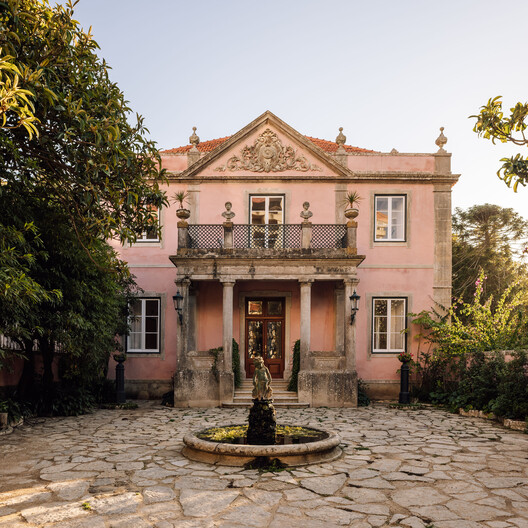
A Romantic-Era House Meets 2025 Construction Practice
António Costa Lima Arquitectos completed a task in Sintra, Portugal, that sounds trivial on paper: restore a 1,900-m² residential house from the early nineteenth century without erasing its genius loci. The result, documented in 2025 by photographer Francisco Nogueira, shows that this type of project is anything but trivial—and that it contains structural lessons for any architect working with historic fabric.
Sintra is no ordinary context. As a UNESCO World Heritage cultural landscape, it carries a regulatory density comparable to interventions in the old-town districts of Geneva or Vienna. The buildings of the early Romantic period—built in the same decades when Caspar David Friedrich painted and Schinkel built—are not only historically valuable but also structurally complex: masonry of unknown composition, roof structures with empirically optimized geometry, ceiling heights that ignore today’s building-code requirements for mechanical systems.
←TODAY: Most European building projects in 2025 involve existing buildings—new construction is the exception, not the norm.
→3012: In the Zurich-3012 horizon, historic structures are not context but primary building material; new-construction thinking is obsolete.
Fulcrum: Adaptive reuse is no longer a niche topic—it is the standard task for which we need methods, not nostalgia.
The Princess Farm is shown in architecture media as an aesthetic object. What the ArchDaily documentation illuminates less: the engineering ecosystem behind the project. P2S handled structural planning, MC Lighting Projects the lighting concept, TOPIARIS landscape architecture, ENESCOORD project management. This is a complete expert network for a single-family house—and for a simple reason: heritage projects generate more uncertainty per decision than new construction. Every layer you open can contain a new unknown.
For BIM specialists and structural engineers, this is precisely the systemic challenge. Parametric models optimized for new construction hit their limits with historic fabric: Scan-to-BIM workflows with Leica or Matterport systems today deliver point clouds with <5 mm accuracy, but translation into a semantically enriched IFC model remains manually demanding. The ETH DFAB lab has shown in several publications that this step—from point cloud to structured geometry—currently consumes 30–60% of the digital project effort in heritage projects. That is the bottleneck, not the sensors.
Atelier: In PAZ courses on Heritage BIM, we address this exact transition: How do you define a Level of Information Need (LOIN) for a building whose geometry becomes final only during execution? The Princess Farm is a sharp case study—1,900 m², six engineers involved, no new-construction floor plan as a starting point.
The trade-off is clear: adaptive reuse preserves substance, identity, and—when done right—embodied carbon. But it costs planning hours that budgets often don’t account for. Anyone advising building owners in the DACH region today must be able to argue this with numbers: according to a 2023 study by the Institute for Building Materials at TU Vienna, the embedded CO₂-equivalent value of a typical Gründerzeit building lies between 300 and 500 kg CO₂e/m²—substance irretrievably lost in demolition.
What the Princess Farm puts on the table is no romantic gesture. It is an argument for methodology: site survey before concept, material analysis before detail design, interdisciplinary engineering from day one—not as retrofit. The collaboration between António Costa Lima and such a structured planning team is not a luxury of a prestige project. It is the minimum that complex heritage work demands.
Concretely: if your next project contains historic fabric, check whether your BIM Execution Plan (BEP) defines an explicit phase for geometric uncertainty. If not, build it in—before you open the wall for the first time.
SOURCE · ↗
PAZ Kaffi · multidisciplinary editorial, led by PAZ Academy
