
PUKKUN Residence: What a 1,100 m² Tropical House in Cancún Teaches About Sense-of-Place Systems
REIMS 502's 1,100 m² PUKKUN Residence in Cancún shows how parallel consultant tracks and site-first logic produce architecture that earns its footprint.
When Site Dictates the Programme
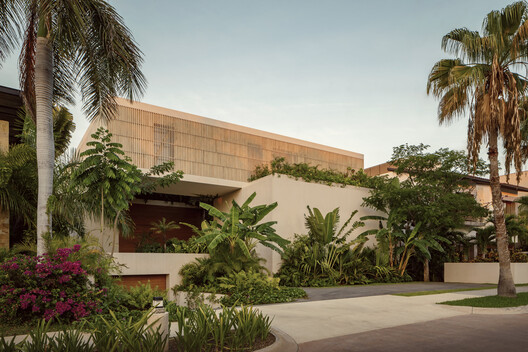
REIMS 502’s PUKKUN Residence, completed in 2023 in Cancún, Mexico, is not a large house trying to look modest. It is a 1,100 m² suburban tropical residence that earns its footprint by making site-responsiveness a structural argument — not a finishing layer. Lead architects Eduardo Reims Hernández and Andrea Maldonado Verduzco, with landscape by Maat Handasa and interior design by Habitación 116, treat the Yucatán context as a load-bearing element of the brief.
←TODAY: Most residential projects above 800 m² in tropical climates treat landscape as decoration applied after structural sign-off.
→3012: In a Zurich-3012 post-scarcity logic, every square metre of programme must justify its climate cost — sense-of-place becomes a carbon argument, not just a poetic one.
Fulcrum: The moment you treat site conditions as design inputs rather than design constraints, the whole system re-orders itself.
The project’s core move, as described by the architects on ArchDaily, is integrating an “extensive architectural program” with a “sensitised sense of place.” That phrase carries more system logic than it might first appear. In tropical residential work, the failure mode is well-known: large programmes collapse inward — air-conditioned boxes sealed against the climate they should be engaging. PUKKUN resists this by distributing the programme across spatial thresholds that respond to Cancún’s heat, light intensity, and vegetation density.
Structurally, the project was delivered with input from two separate engineering consultants — S+S Obra and 4D Estructural — which suggests deliberate redundancy in the structural coordination loop. For a residence of this scale, splitting structural oversight is either a risk (coordination overhead, potential contradictions in CDs) or a strength (specialised input at different building systems). The contractor, Rogerio Ruiz Ramírez, would have been the integration point. This is the kind of procurement topology that rarely appears in project credits but shapes whether the architecture actually builds as designed.
From a systems perspective, what PUKKUN demonstrates is a parallel-track design model: landscape (Maat Handasa), interior (Habitación 116), and architecture (REIMS 502) appear to have operated as co-equal inputs rather than a sequential hand-off chain. As the ETH-DFAB’s research on integrated design processes has consistently shown, projects where landscape and interior consultants are brought in at concept stage — not after massing is fixed — produce measurably better bioclimatic performance and spatial continuity. PUKKUN’s photography, documented by César Béjar, supports this: indoor-outdoor thresholds read as designed, not retrofitted.
For DACH practitioners, the relevant signal here is not tropical architecture per se. It is the team topology. In the Swiss context, SIA 102 defines the Architektenleistung in phases that can inadvertently push landscape and interior consultants downstream. The PUKKUN model — parallel from the start — is an argument for restructuring those consultant onboarding moments closer to Phase 2 (Vorprojekt) rather than Phase 4 (Projektierung).
Atelier: In PAZ’s HIM (Human-Integrated Methodology) framework, this maps to the “context as co-author” principle: site, climate, and programme are inputs at the same level, not a hierarchy where structure comes first and landscape comes last. If your next residential project above 500 m² doesn’t have a landscape consultant in the kick-off meeting, you are already building in a constraint you will spend money correcting later.
The trade-off is real: parallel-track models increase coordination load in early phases, require clearer brief ownership, and demand a project lead who can synthesise competing inputs without flattening them. REIMS 502 had two structural engineers and three distinct design practices contributing. That only works if the lead architect holds a strong enough conceptual thread — “sense of place as structural argument” — to keep the team oriented when the details diverge.
The concrete action: pull the PUKKUN project page on ArchDaily, read the full credits list, and map the consultant network as a systems diagram. Then do the same for your last completed residential project. The difference in that diagram — who was in the room and when — is often the difference between a house that reads as integrated and one that reads as assembled.
SOURCE · ↗
PAZ Kaffi · multidisciplinary editorial, led by PAZ Academy
