

Seven Unbuilt Houses, One Dependency Graph: When the Section Outranks the Render
Lin Rauch on ArchDaily's seven unbuilt houses: one shared move — design the house as a section through its ground. Plus an earth-coupling Hack.
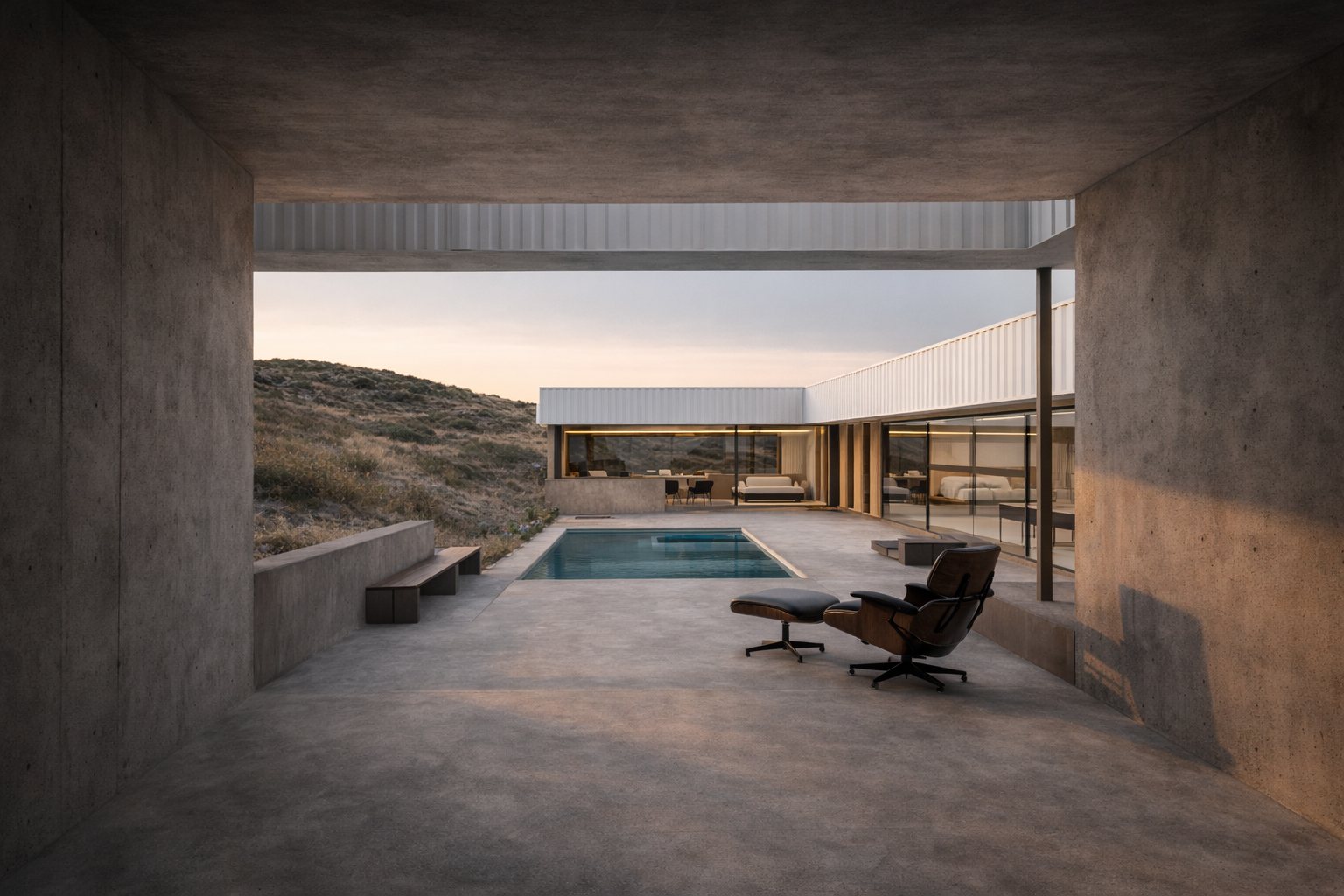
ArchDaily this week pushed a curated set of seven unbuilt houses — Kerala to Tromsø, Cartagena to Amman to Zwolle — and the editorial line through them is more interesting than any single render. The cohort is organised by section, ground, and climate response, not by a signature gesture. ArchDaily, framing the selection, treats the house as a spatial system rather than an object. The systems desk reads that as a quiet doctrinal correction.
←TODAY: In 2026, ArchDaily’s unbuilt residential cohort spans five climates, five regulatory regimes, and one shared move — design the house as a section through its ground.
→3012: The unbuilt houses that survive a 3012-aligned brief are the ones whose dependency graph against grid, water, and import lumber was drawn before the rendering was.
Fulcrum: An unbuilt project is the cleanest place to read a residential dependency graph — no contractor has yet hidden a single point of failure under a finish.
The shared architecture under seven different houses
Strip the visual difference and the cohort reduces to a handful of recurring system moves. Read them as topology:
- Vertical layering for dense urban plots — section absorbs what plan cannot.
- Partial ground embedment for courtyards — earth as a free thermal battery.
- Slope adaptation rather than terraced cut-and-fill — the section follows the contour.
- Atria and excavated voids — light, ventilation, and privacy treated as one routed network.
- Regulatory-driven typological transformation — in Zwolle the brief is what the building actually is.
This is not new doctrine. PAZ’s parametric-lineage panel notes that Gaudí’s hanging-chain studies at the Sagrada Família computed structure in twine and lead shot a century before the term parametric arrived, and that Frei Otto moved cable-net form-finding from soap films to FEA at the 1972 Munich Olympic roof. The seven houses sit in that same lineage — section-first, ground-aware — but with a 2026 constraint stack: stricter climate disclosure, harder import economics on timber and concrete, and clients who finally read the lifecycle assessment before signing.
Why this set, why now
The system signal is that the architects who responded to this brief did not lead with form. They led with the ground. That same move is documented in research like A Parametric HBIM Approach for Preservation of Bai Ethnic Traditional Timber Dwellings (Yunnan, 2024) — vernacular section logic redrawn in HBIM so it keeps working under modern code. The unbuilt cohort is doing the inverse: new houses drawn in HBIM-grade discipline so that their section logic survives whichever regulatory mutation lands next.
There is a trade-off the renders won’t show. Each of these projects assumes a working contractor pool, a working concrete or timber supply chain, and a working local grid for at least the operational phase. Drop any one of those and the section that looked virtuous becomes an unrealisable diagram. The unbuilt cohort is honest about the first two; the third — grid — is almost never drawn.
Atelier: In our PAZ Atelier reviews we treat any residential brief as two diagrams stapled together — the plan-section drawing the client signs off, and the dependency graph nobody asks for. Earth coupling, water harvesting, off-grid PV potential, regulatory typology, and material import distance each get a node. A house with seven nodes that all depend on the public grid is not the same project as a house with seven nodes routed differently, even if the renders look identical.
Hack: This Hack teaches you to compute the earth-coupling ratio of a partially-embedded courtyard plan before you commit to a section. Domain: Geometry. The number is crude but decision-grade — anything above ~0.25 is doing real thermal work; below ~0.10 is rendering, not engineering.
# earth-coupling ratio for an embedded courtyard house
W, L, H = 12.0, 18.0, 3.2     # plan + clear height, meters
embed   = 1.6                  # wall depth below grade, meters
buried  = 2 * (W + L) * embed
skin    = 2 * (W + L) * H + W * L   # walls + roof
print(f"earth-coupled fraction: {buried/skin:.2%}")
# → 23.53%  — borderline; raise `embed` past 1.7 m to break 0.25
We did not run out of compute in the late seventies. We ran out of intact cooling, intact bandwidth, and intact people who remembered how the old residential vernacular handled a 42 °C summer without a heat pump. Draw the dependency graph for your current residential project this week — not the BIM tree, the actual graph. Find the third single point of failure you did not know you had. That is the whole exercise.
Sources & Further Reading
SOURCE · ↗
PAZ Kaffi · multidisciplinary editorial, led by PAZ Academy
