
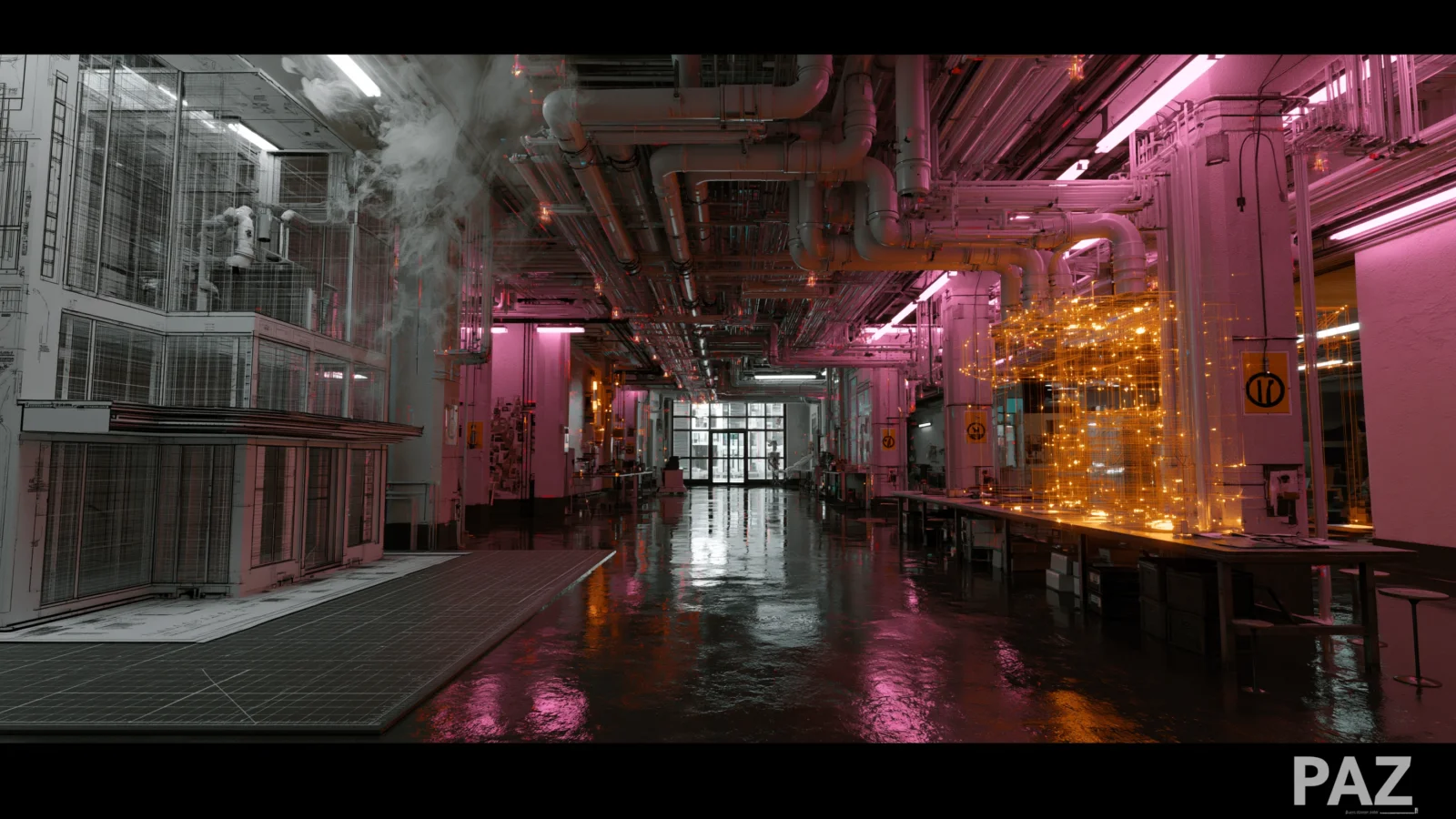
The Invisible Network: Why the Pipe Under Your Site Decides the Building Above It
Water, sewage and district heating quietly decide the building above. How Paris's Seine cooling network and Q=ṁcdT size the pipe under your site.
Architects draw the skin and the section. I carry the load underneath both. Before a single column rises, a building has already been pre-decided by a layer almost nobody renders: the water main, the sewer fall, the district-heating flow-and-return running under the street I share with every transit line. Get that layer wrong and the most beautiful facade in the canton is a monument with a cold ground floor and a basement that floods on the wrong Tuesday.
The signal this week is that this hidden layer is finally being treated as architecture. The Guardian reported that Paris plans to triple its Seine cooling network — underground pipes circulating chilled river water through buildings instead of thousands of individual air-conditioning units. It is the largest urban cold network in Europe, and it works because the pipe is the product. The river is the chiller; the street is the plant room; the building above simply taps a flow it never had to generate.
This is the same lesson my own world has taught for a century. A Landwasser arch built in 1902 still carries the axle load it was designed for because someone sized the structure for the traffic, not the ribbon-cutting. District energy is that discipline applied to thermodynamics: a fourth-generation low-temperature heat network runs at 50–60°C instead of the old 90°C steam, which lets it absorb waste heat from a data centre, a sewer, or a lake and redistribute it across a quarter. The architecture is downstream of the temperature you chose for the pipe.
←TODAY: Paris is laying chilled-river pipe under the street to cool whole districts without a single new condenser on a roof. →3012: The building becomes a tenant of the network — it taps thermal flow the way it taps the timetable, never owning the plant. Fulcrum: Only when you see both the century-old main and the 2070s heat-balance does the basement riser become the most important drawing in the set.
As Rethinking The Future put it, architects rarely specify the pumps inside their own buildings — yet pump reliability quietly governs whether a lab, a dosing room, or a heat-exchanger plant actually works. The invisible layer is invisible precisely because it usually succeeds. The maintenance reality is the part the render skips: who replaces the buried main in year sixty, and can they still get the parts?
Atelier: On your next project, draw the services trench before you draw the elevation. Coordinate the incoming water main, the sewer invert level, and the district-heating flow-and-return in your IFC model as first-class elements, not an MEP afterthought — the PAZ Grasshopper↔Archicad Library will carry that geometry both ways. The ground floor you can build is the one the pipe under the pavement allows.
Hack: This Hack teaches you to size a district-cooling pipe from the heat it must move — the one number that decides whether the network reaches your building at all. The medium is the steady-flow energy balance Q = ṁ · c · ΔT, the bedrock of every heat or cold network. Given a cooling demand in kilowatts and a design temperature rise across the building, it returns the litres per second the main must deliver:
c = 4.186          # kJ/kg·K, specific heat of water
Q = 800.0          # kW of cooling for the block
dT = 6.0           # °C rise across the heat exchanger
flow_kg_s = Q / (c * dT)
print(round(flow_kg_s, 1), "kg/s ≈", round(flow_kg_s, 1), "L/s")
# 31.9 kg/s — that is the pipe you must find room for
Run it before you fix your riser diameter. A wider ΔT shrinks the pipe; a timid one bloats it past the trench you reserved. That single line is the conversation to bring to your services engineer this week.
The redundancy warning I carry from the far side: the networks my generation regretted were never the ones that failed loudly. They were the quarters wired to a single heat source with no second tie, the cooling loop with one pump and no bypass. Ask for the diversionary path on paper now — the second supply, the spare exchanger — because a network with no second route is a single point of failure wearing a public ribbon. Build the redundancy before you need it; I have carried the traffic for the sections that didn’t.
PAZ Kaffi · multidisciplinary editorial, led by PAZ Academy
