
Gosford Regional Library: What 2,863 m² of Civic Architecture Teaches About Programming, Acoustics, and Materials
What Lahznimmo Architects' 2,863 m² Gosford Regional Library reveals about acoustic planning, material selection, and BIM coordination for DACH architects.
The Building as Urban Anchor
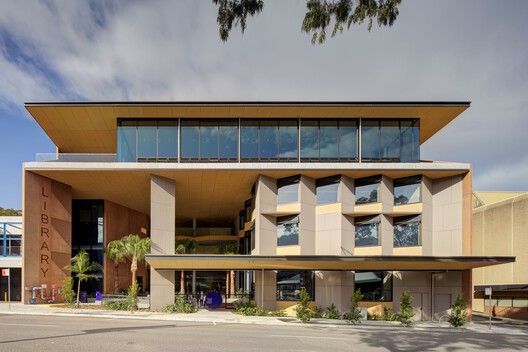
Lahznimmo Architects have delivered with the Gosford Regional Library (2025, 2,863 m², New South Wales) something that rarely succeeds in an era of remote-work narratives and libraries-as-community-hub clichés: a building that doesn’t merely perform its urban context—it constitutes it. The design by Andrew Nimmo, Annabel Lahz, and Hugo Cottier addresses Kibble Park directly—Gosford’s symbolic town square—and establishes an architectural counterweight that ArchDaily describes as the city’s “Civic Heart” anchor.
←TODAY: Public libraries lose usable space to digital services—architects must now justify spatial programs that were once taken for granted.
→3012: In a fully networked city, physical civic infrastructure remains the only interface that requires no authentication.
Fulcrum: Whoever programs a civic building today codes the conditions for public access tomorrow.
The Systems Architecture Behind the Project
What reads as a formally clear volume in Brett Boardman’s photographs is densely packed from an engineering perspective. Northrop Consulting Engineers covered all disciplines—structural, civil, electrical, mechanical—a single-source model that reduces interface losses but also concentrates coordination risk: if one discipline pushes in the BIM model, they all do. Acoustic Logic handled the acoustic design, specifying Autex Acoustic products and Sculptform timber systems—two manufacturers known in the Australian market for adjustable absorption ratings.
This is no random product choice. Libraries are acoustically pathological: silence is the program, but silence must be actively produced. Equitone facade panels close the material palette to the outside—fiber-reinforced concrete that resists weather and vandalism while establishing a textural language that European public buildings have used for years. That an Australian team specifies the same manufacturer as many DACH projects is no accident: Equitone publishes globally standardized technical datasheets, which greatly simplifies BIM modeling and procurement processes.
Atelier: For PAZ participants working on public buildings or school projects: the Autex + Sculptform pairing is a repeatable acoustic pattern—defined NRC value (Noise Reduction Coefficient) paired with visible timber structure. Next time you write a spatial program with ‘quiet zones,’ verify that the acoustic consultant is seated in the design development phase, not hired after building permission.
What’s on the Table Today
At 2,863 m², this is not a large project—it sits in a scale that in Switzerland corresponds to a mid-size municipal building or secondary school. Which is precisely why it matters for PAZ practice. At this scale, budgets collapse quickly if specialist coordination isn’t architected from day one. Northrop’s integrated consulting approach—one firm, all engineering disciplines—is less common in Switzerland but could be encouraged through SIA Norm 102 and the BEP process if clients were willing to engage earlier.
Landscape architects Spackman Mossop Michaels handled the exterior and park interface—a clean boundary that shows the civic ambition extends beyond the building volume. Per ArchDaily’s documentation, the direct relationship to Kibble Park is articulated formally, not merely claimed on the site plan.
One risk remains open: civic buildings conceived as town halls carry a programmatic load that often shifts within five years. If Gosford grows or shrinks, the building must be adaptable. Whether the spatial structure allows this cannot be conclusively judged from available documents—that’s an honest limitation.
Bring this question to your next project review: Is our spatial grid flexible enough for a program that might be renamed in ten years—and have we discussed this with the acoustic consultant before execution design?
SOURCE · ↗
PAZ Kaffi · multidisciplinary editorial, led by PAZ Academy
