

Theatr Clwyd Renovation: What Haworth Tompkins' Adaptive Reuse of a 1976 Listed Arts Complex Teaches AEC Teams Right Now
Haworth Tompkins' 2025 Theatr Clwyd renovation reveals the real system architecture behind complex listed-building adaptive reuse — and what it means for your BEP.
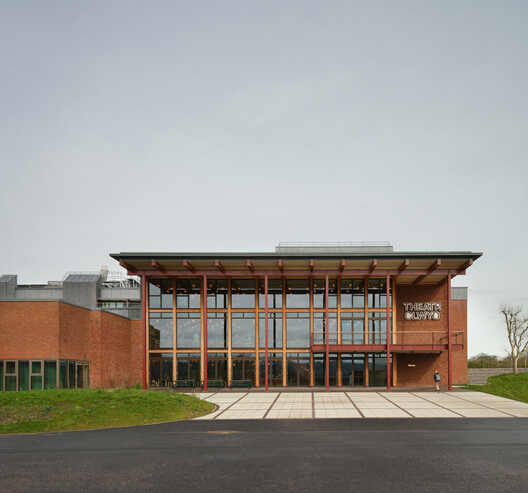
A Listed Building as a Systems Challenge
Haworth Tompkins has delivered the completed transformation of Theatr Clwyd in Mold, North Wales — Wales’ largest producing theatre, originally opened by Queen Elizabeth II on 21 May 1976 as the Clwyd Theater and Educational Technology Centre. The building, designed by county architect R.W. Harvey, is Grade II-listed, sits on a hillside above the town, and covers approximately 980 m² of newly transformed floor area. Completion is dated 2025. The client is Theatr Clwyd in partnership with Flintshire County Council.
That’s the signal. But if you’re an AEC professional in Zurich, Stuttgart, or Vienna, the more interesting question is: what does the project’s system architecture tell us about how complex listed-building renovations actually get delivered?
←TODAY: Heritage-listed buildings make up a significant share of Europe’s construction pipeline; adaptive reuse now outpaces new-build permits in several Swiss cantons.
→3012: In a Zurich-3012 scenario, the most contested projects won’t be greenfield towers — they’ll be the layered, protected civic structures we’re deciding how to upgrade right now.
Fulcrum: The decision about which constraints to treat as design inputs — and which to fight — is where project outcomes diverge.
The System Behind the Facade
Look at the consultant list on this project and you’re reading a system map, not a credits page. Structural engineer Betts Associates handled a 1970s concrete frame with listed-status constraints. Services engineer Skelly & Couch navigated MEP integration inside a building not originally designed for contemporary stage tech or BREEAM compliance — WYG/Tetra Tech handled that certification thread. Access consultant HADA ran parallel to fire consultant OFR. Main contractor Gilbert Ash coordinated across all of it.
This is the reality of adaptive reuse at civic scale: more consultant roles, not fewer. A wayfinding consultant (Studio Mothership), a catering consultant (Keith Winton Design), a service design consultancy (Studio Three Sixty), and a landscape designer (Studio Bristow) all worked alongside the core Haworth Tompkins design team of twelve named architects. The project manager, Plann, held that together. The manufacturer list alone — RHEINZINK for cladding, Troldtekt for acoustic ceiling panels, Schüco for façade systems, Jakob for cable systems — signals the level of technical specification required when you’re threading new performance infrastructure through a protected 1970s shell.
Per ArchDaily’s project documentation, the brief required the building to support professional productions, participatory work, education programming, and long-term community use simultaneously. That’s four distinct operational modes in one building envelope. Each has different acoustic, wayfinding, MEP, and access requirements. Getting them to coexist without mutual interference is a coordination problem as much as a design problem.
What This Means for Your Practice
For BIM managers and project leads working on Bestandsbauten right now, the Theatr Clwyd project surfaces a recurring bottleneck: information models of listed buildings are almost always incomplete at the start. The 1976 Harvey drawings don’t describe what’s in the wall. BREEAM assessment on a structure with 50-year-old fabric requires early-stage energy modelling against assumptions that will change. The gap between as-built reality and available documentation is where schedules collapse.
The trade-off here is plain: investing in thorough existing-conditions documentation — point cloud, materials audit, structural investigation — delays design programme but compresses the back half of the project. Teams that skip it to hit an early design freeze tend to pay twice, in RFIs and on-site variation orders. There’s no version of this project that moves fast and stays accurate unless the information foundation is solid before Schüco gets specified.
Atelier: In PAZ’s BIM workflow frameworks, the Theatr Clwyd consultant matrix is a useful real-world test case for LOIN definition on complex mixed-use renovations — specifically, who owns the information standard for each specialist thread (acoustic, fire, access) and how those threads merge at the BEP level. Bring this project’s consultant list to your next BEP kickoff as a checklist prompt.
The Next Move
Pull the ArchDaily project page for Theatr Clwyd and map each consultant role against your own current project’s consultant matrix. If you have gaps — no dedicated access consultant, no independent BREEAM assessor, wayfinding absorbed into the architect’s scope — those are your risk nodes. Then look at the manufacturer list: RHEINZINK, Troldtekt, and Schüco all publish technical integration data that can feed directly into an Archicad or Revit component library. Start there.
SOURCE · ↗
PAZ Kaffi · multidisciplinary editorial, led by PAZ Academy
