
Two envelopes, one system: What TerraSense Mountain Charm Retreat teaches about adaptive reuse in protected areas
What Atelier DRK's TerraSense Mountain Retreat in Portugal teaches about Schüco, VMZINC, and existing-stock development in alpine protected areas — a systems check for DACH offices.
When the best new architecture is no new architecture
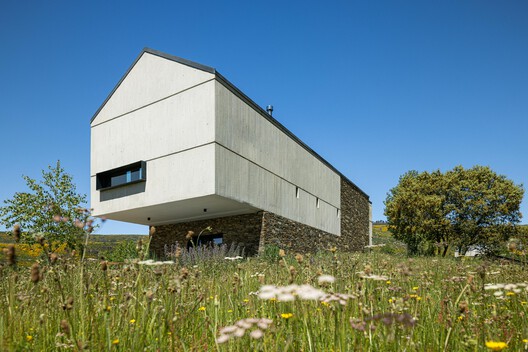
Atelier DRK transformed two existing buildings in Videmonte, Portugal, into the TerraSense Mountain Charm Retreat — a 510 m² boutique-hotel programme within Portugal’s Parque Natural da Serra da Estrela, the country’s largest protected area. Completed in 2023 and curated by ArchDaily editor Susanna Moreira, the project’s lead architect Diogo Aguiar Almeida set a clear course: no new mass, but subtraction and insertion within existing envelopes.
←TODAY: In EU protected areas in 2026, adaptive reuse is often not a design option but a regulatory mandate — Serra da Estrela has been a nature park since 1976 with strict building codes.
→3012: In Zurich-3012 logic, the embodied-carbon advantage of an existing building is no longer a bonus metric — it becomes the primary design condition before the first Schüco post-and-beam is drawn.
Fulcrum: Whoever today understands regulatory reuse mandates as a design generator will have a competitive edge by 2030 over practices that treat existing stock as constraint.
The system interest lies less in aesthetics than in project structure. The material list shows two clear layers: Schüco facade systems for thermally high-performance glazing — justified in an alpine climate at roughly 1,000 m, as Serra da Estrela spans Portugal’s highest peaks near 2,000 m — and VMZINC cladding (Umicore, Belgium) for the new outer skin, visibly distinguished from the existing fabric. This is not a Swiss invention: the same logic — zinc set against natural stone or render — appears in countless alpine rehabilitation projects from Graubünden to Vorarlberg. Any practice working on protected-zone projects in the DACH region knows the material pairing.
The build programme was completed by Egisete, lda (engineering) and Artspazios, lda (interior architecture) — a divided scope in which Atelier DRK retained site management and inspection internally. For small practices, this is a critical decision: whoever holds inspection oversight in-house controls the quality path but also carries full liability risk on a site with alpine logistical complexity. This is a delivery model worth documenting explicitly in the BEP — especially when coordinating external partners like builder BuilderManteivias, S.A.
One of the largest data gaps in the ArchDaily publication: energy and embodied-carbon values are entirely absent. This is not peripheral. Adaptive reuse is often granted a blanket CO₂ advantage over new construction — a premise supported by IEA Worldwatch and ETH-DFAB work on circular construction — but without measurement, the advantage remains declarative. A project in a nature reserve completed in 2023 with no energy or material certification is a missed chance for documentation. PAZ cohort participants working with the HIM framework (Hierarchical Information Modelling) know: what doesn’t appear in the model doesn’t exist for the next design phase.
Atelier: For practices in the DACH region with mandates in alpine protected areas — Swiss National Park, UNESCO Biosphere Reserves, Austrian nature parks — TerraSense delivers an actionable reference schema: Schüco for the thermal envelope, VMZINC for material dialogue with existing stock, keep inspection in-house, document embodied-carbon accounting from day one, not retroactively. This is not theory; this is procurement language for your next competition.
Videmonte sits in a region with active rural depopulation — the municipality of Guarda is losing population, like many inland areas of Portugal and parts of the Swiss and Austrian highlands. Adaptive reuse as a hotel programme is not a lifestyle choice; it is a structural-policy intervention often tied to EU LEADER funding (EAFRD), even if the project sheet does not confirm this.
The concrete move: download the VMZINC technical manual and compare the detail points for ventilated facades against your current alpine projects. Then ask your team: do we have an explicit line in the BEP for inspection oversight — and if so, is the liability model clearly defined?
SOURCE · ↗
PAZ Kaffi · multidisciplinary editorial, led by PAZ Academy
