
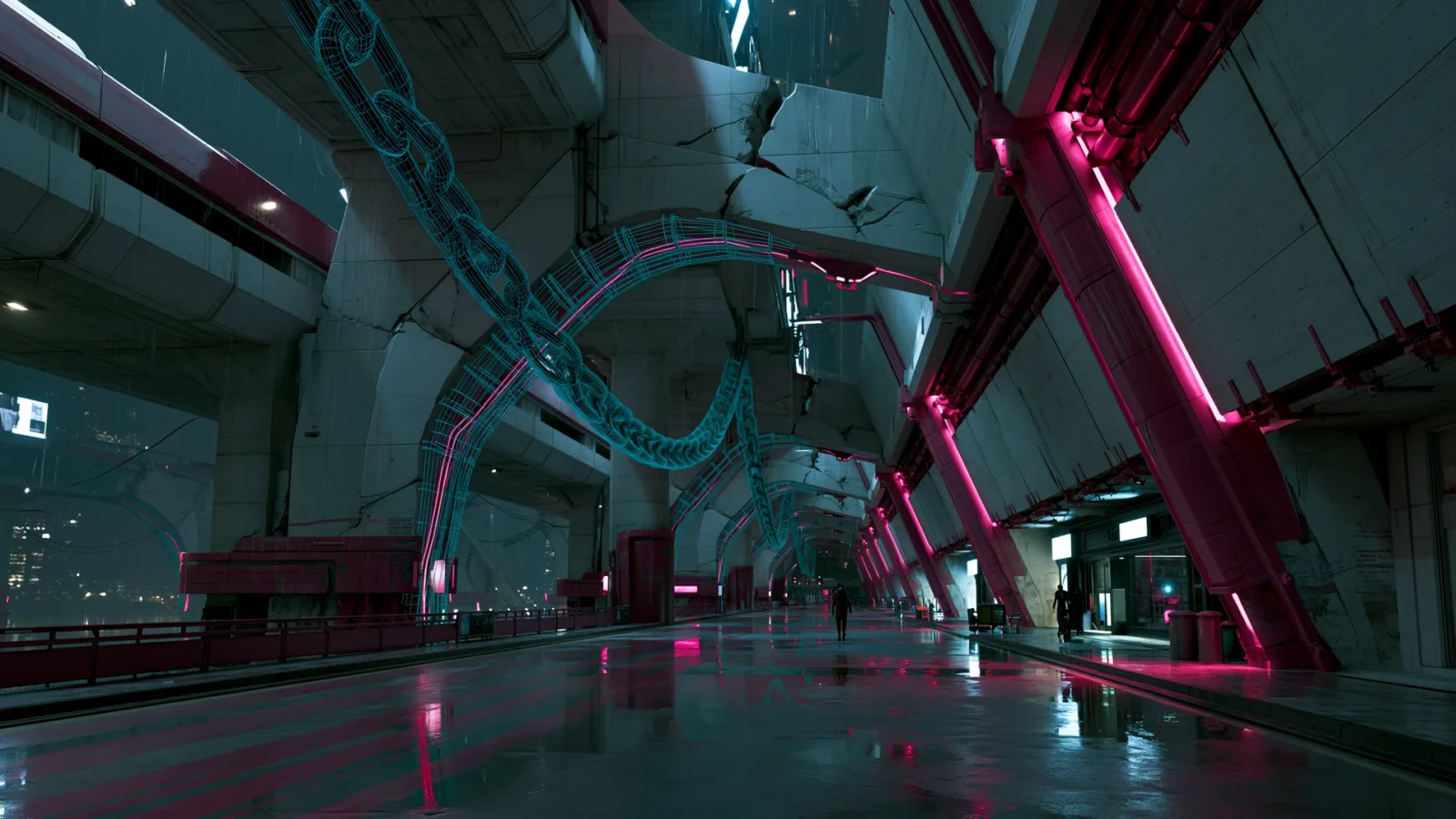
As Hangs the Chain, So Stands the Arch: Form-Finding from One Curve
Hooke's hanging-chain principle, the catenary cosh, and Swiss form-finding from Isler to ETH's RhinoVAULT — with a 3-line Python arch you can run today.
Hang a chain between two nails and you have already solved a structural problem that bending-stiff thinking takes a semester to fumble. Every segment of that slack line sits in pure tension; the curve it settles into — y = a·cosh(x/a), the hyperbolic cosine, the catenary — is the only shape that resolves the equilibrium. There is exactly one parameter, a. Change it and the whole curve scales; nothing else is free. That is the cheapest, most honest geometry in all of architecture, and this week’s PAZ ACTION sketch ships it as thirty lines you can run, skew, and download.
What it is
A catenary is not a parabola. Galileo guessed parabola in 1638; Jungius killed that guess in 1669; and in 1691 Leibniz, Huygens, and Johann Bernoulli independently derived the true cosh, answering a challenge Jakob Bernoulli had thrown down. The distinction matters on a real desk: a cable under uniform horizontal load (a suspension-bridge deck) is a parabola, while a cable under its own uniform weight is a catenary. Load the chain at a point and you get neither — you get a funicular polygon, straight segments hinging at the load. The smooth catenary is the limit case as the weight spreads out. Get this wrong in a model and your thrust line lies to you.
Why it works
Robert Hooke wrote the whole discipline in one sentence in 1675: “As hangs the flexible line, so but inverted will stand the rigid arch.” Flip the hanging curve and the sign of every internal force flips with it — pure tension becomes pure compression. An arch shaped on an inverted catenary carries its self-weight through the thickness of stone without bending, and bending is the one thing masonry cannot survive. This is form-finding: you do not draw the geometry and then check it, you let force equilibrium hand you the shape. The architect specifies the conditions; gravity specifies the form. As PAZ’s Kaffipedia catenary panel puts it, the shape is found by the forces.
Origins
The lineage is unusually clean. Hooke (1675) → Gaudí’s weighted-string models for the Colònia Güell crypt and the Sagrada Família (1890s), every string pre-carrying the load its column would later carry in stone → Frei Otto’s hanging nets and soap films at Stuttgart (Mannheim Multihalle) → and the Swiss anchor of this whole story, Heinz Isler, who froze hanging wet cloth under gravity, inverted it, and cast it as thin concrete — the Deitingen service-station roof in Solothurn still stands as proof. The maths went numerical with Schek’s Force Density Method (1974) and Day’s Dynamic Relaxation (1965).
←TODAY: In 2026 form-finding is a laptop move — ETH Zürich’s Block Research Group ships RhinoVAULT free, and Kangaroo solves a hanging net live inside Grasshopper. →3012: The shells that survive to the Zurich-3012 horizon are the ones whose derivation survived — the objective written down, not just the mesh exported. Fulcrum: A form-found shape is only defensible because you can see both ends — the gravity that made it and the review that must later trust it.
In practice
Atelier: The Block group’s Armadillo Vault (Venice, 2016) and the NEST HiLo roof in Dübendorf are not history — they are the buildable end of the same chain you can hang in a browser, and they minimise bending, therefore material, therefore embodied carbon. That is the live argument for masonry shells and 3D-printed concrete right now.
Hack: This Hack teaches you to read an arch as an upside-down chain by flipping a single sign. The DOMAIN is geometry: construct the curve, then invert it. Three lines in Python is the whole idea; the ACTION sketch just animates it with a Verlet particle-spring chain so you can drag the anchors live.
import numpy as np
a = 1.8                       # one parameter sets the entire curve
x = np.linspace(-3, 3, 60)
chain = a*np.cosh(x/a)        # hangs in pure tension
arch  = -chain                # Hooke's inversion -> pure compression
Run it, then walk the path the brief lays out: plot cosh for varying a, build a pinned Verlet chain, invert it to an arch, extend the line into a 2D net for a shell, and hand the result to RhinoVAULT or Kangaroo for a real structural read. If you want the tooling under your hands, McNeel Europe’s Grasshopper Level 3 course (27–29 May 2026, with former Zaha Hadid architect Ping-Hsiang Chen) spends its second day on exactly this — physics-based form-finding with goals and forces.
One warning from the far side: the parametric work my generation came to regret was never the ugly form, it was the elegant form whose logic nobody could rebuild after the plugin went dark. A generated shell with no stated objective is a beautiful guess you cannot defend in a structural review. So this week, before you export anything, make the tool tell you which energy it minimised — and write down the a. Keep the maths; the file format will not survive you.
PAZ Kaffi · multidisciplinary editorial, led by PAZ Academy
