

13 500 m² of Programmed Ambiguity: What Babel Community Teaches Us About Coliving at Scale
D'HOUNDT+BAJART's 13 524 m² Babel Community in Villeneuve-d'Ascq exposes the regulatory gap every European architect designing coliving must solve now.
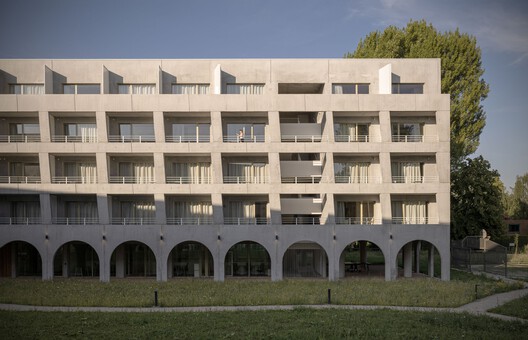
When the Typology Itself Becomes the Brief
A 13,524 m² purpose-built coliving residence completed in 2025 in Villeneuve-d’Ascq — suburb of Lille, Métropole Européenne de Lille — sounds straightforward enough until ArchDaily classifies it under both Hospitality Architecture and Residential Architecture simultaneously. That dual tag is not editorial sloppiness. It is a systems signal worth unpacking.
The project is The Babel Community, designed by Lille-based D’HOUNDT+BAJART Architectes & associés (lead architects Vincent D’Houndt and Bertrand Bajart, design team Nicolas Questroy and Nathan Exposito) for the French coliving operator of the same name. Structural engineering: ABAC. MEP: ETC. Environmental sustainability: MODUO and auddicé. Façade: EQUITONE fibre-cement panels — Belgian origin, Eternit group, a cladding system any Swiss Minergie-envelope conversation will recognise immediately.
←TODAY: European coliving operators are commissioning institutional-scale, ground-up buildings — 13 500 m², purpose-built, in 2025 — not converting student dorms.
→3012: The Zurich-3012 horizon assumes residential typologies are fluid infrastructure, reclassified at lease rather than at permit.
Fulcrum: The gap between today’s regulatory binary (residential OR hospitality) and tomorrow’s fluid reclassification is exactly where architects lose — or win — the next decade of housing work.
The System Behind the Signal
Coliving emerged in Europe post-2015 as a response to three converging pressures: urban housing affordability, demand for flexible leases, and the remote-work restructuring of daily life. Operators such as The Babel Community, Colonies, and Cohabs moved fast; planning codes moved slow. France has been actively developing a distinct legal framework for coliving — separate from co-ownership statutes and student-residence regulations — and Babel’s 2025 completion lands squarely inside that still-unsettled legislative window.
Villeneuve-d’Ascq is not an accidental site. It is a 1970s-era planned new town built around the Université de Lille campus and major technology parks, with a demographic base of young professionals and students — the exact market coliving operators target. The Métropole Européenne de Lille also draws partial EU cohesion funding for post-industrial regeneration, which shapes land availability and permitting timelines in ways that greenfield suburban sites in Switzerland or Germany do not always replicate.
At 13,524 m², this is not a boutique conversion. It is institutional-scale, ground-up construction — the kind of brief that requires a BIM team to resolve unit-mix programming, shared-amenity zoning, and acoustic compartmentalisation across a building that must simultaneously satisfy hotel-grade service expectations and residential habitation standards. That is a hard brief. The fact that D’HOUNDT+BAJART pulled in dedicated sustainability consultants (MODUO, auddicé) from early stages reflects what SIA 112 integrated-planning readers will recognise: you cannot bolt environmental performance onto a complex mixed-use programme at the end.
On Your Desk This Week
The dual typology classification creates a concrete regulatory headache that Swiss architects navigating Nutzungsänderung under cantonal codes will find familiar. Fire compartmentalisation rules, accessibility standards, and energy-performance obligations diverge depending on whether a floor is classified residential or hospitality. When a building is functionally both — shared kitchens and lounges operating like hotel amenities, private rooms tenanted like apartments — the compliance path is not obvious. The risk: design teams default to whichever classification is more permissive, and the building then fails operator expectations or insurance underwriting when the other standard is invoked.
The material specification list offers a secondary read. EQUITONE rainscreen panels, Knauf drylining, Florim tiles, Hoyez windows: these are not boutique selections. They are the industrialised, cost-certain palette of a developer-operator who needs replicable performance across multiple sites. Knauf and Florim both carry strong Swiss market presence; the spec sheet here functions almost as a procurement template for the next Babel building — or for a Swiss operator watching how the French model scales.
Atelier: If your office is fielding early enquiries for coliving or co-living-adjacent briefs — and in Zurich, Basel, and Geneva you should expect them — start the BIM setup with the typology question coded explicitly into your level-of-information needs (LOIN) matrix. Define early whether shared amenity zones carry residential or hospitality classification in your cantonal model; the fire-zone and accessibility geometry downstream depends on it.
The Babel Community project, as documented via ArchDaily and the associated manufacturer credits, gives us the bones of a system but not the full narrative — unit count, cost per m², and any HQE or BREEAM certification target are not yet published. That gap is itself informative: the developer-operator brand and the building share an identity (both named Babel Community), but the programme data remains proprietary. Watch for the operator’s next site announcement; the replicable spec palette suggests it is coming.
Pull the EQUITONE technical data sheet and map it against your current façade U-value targets. Then ask your team: if this brief landed tomorrow, which cantonal use-classification would you file under, and why?
SOURCE · ↗
PAZ Kaffi · multidisciplinary editorial, led by PAZ Academy
