

The Shude library: 379 m² and the cost of missing as-builts
Modum Atelier's 379-m² library renovation in Chengdu shows how to plan without building documentation—and what DACH BIM professionals can learn.
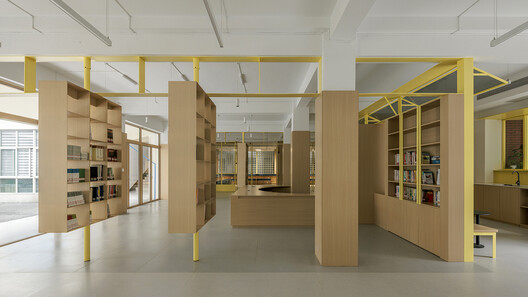
When building documentation is missing—and you must build anyway
Modum Atelier reconfigured the Chengdu Shude Experimental Middle School library to 379 m² in 2025. Sounds like a modest renovation. Systemically, it’s a teaching case: the building dates from the 1970s–80s, has survived multiple renovation cycles and ownership changes, and has no reliable building documentation. The original design is no longer reconstructible. Yet the school now demands: reading areas, meetings, flexible teaching, teacher workstations, exhibitions—all within a single orthogonal grid footprint.
This is no outlier. It’s the standard state of global school building stock.
←TODAY: Thousands of 1970s-era school buildings are being renovated across Europe—often without reliable as-built plans in BIM format.
→3012: In the Zurich-3012 horizon, buildings are living data systems; each layer leaves a verified trace in the digital twin.
Fulcrum: The difference between today and 3012 is not technology—it’s the discipline to generate data before you build.
The system problem: orthogonal grid, polyvalent requirements
Modum Atelier—lead architects Zhou Ruizhe and Yang Junbo—call their approach ‘Generating a Strategic Prototype.’ The term is more precise than it sounds at first. Without a reliable as-built model, you cannot optimize—you can only work prototypically: make assumptions, keep installations reversible, anchor flexibility structurally. This is not a design style; it’s an epistemological necessity.
Organizing five uses—reading, meetings, flexible teaching, teacher prep, exhibitions—within a single orthogonal grid is a classic multi-constraint problem. Anyone who models this in BIM knows the crux: each use demands different acoustic, lighting, and furnishing requirements. Without an existing building model, you lack the baseline for any of these simulations. According to a 2023 buildingSMART International report, more than 60% of renovation projects worldwide lack reliable digital building data—the Shude library is thus more representative than exceptional.
Engineering was handled by Chengdu Tianzhongcheng Information Technology Co., Ltd.—a signal that the architecture/technology interface was intentionally digital, even though the baseline material remained analog.
What this means at the desk
For BIM coordinators and planners in the DACH region, the lesson transfers directly. Whoever is renovating a school, office building, or industrial hall from the 1980s faces the same question: Where is the as-built? The answer is often: nowhere, or in a format no current tool can read.
The instinct to start immediately with laser scanning (e.g., Leica RTC360 or Faro Focus) is correct. But scanning alone doesn’t solve the system problem. The point cloud must be transformed into a semantically enriched BIM model—with material specs, layer compositions, structural assumptions. Tools like Autodesk Revit with Scan-to-BIM plugins or the open-source IfcOpenShell framework can structure this transition. It costs time upfront; you won’t miss it in the middle of the project.
The second lesson from Shude: polyvalence must be spatially and technically prepared. Flexible use is not a license for vague floor plans—it’s higher planning effort, not lower.
Atelier:In the PAZ context, such as in Cohort projects with renovation tasks, it’s worth defining an explicit ‘data status’ for the existing building before each design step: What is measured? What is assumed? What is unknown and must be physically verified during the intervention? This simple three-column protocol—known, assumed, open—prevents assumptions from silently becoming certainties.
Modum Atelier’s project is documented on ArchDaily, photography by Guowei Liu. Look at the floor plans: what they show is as revealing as what they cannot.
SOURCE · ↗
PAZ Kaffi · multidisciplinary editorial, led by PAZ Academy
